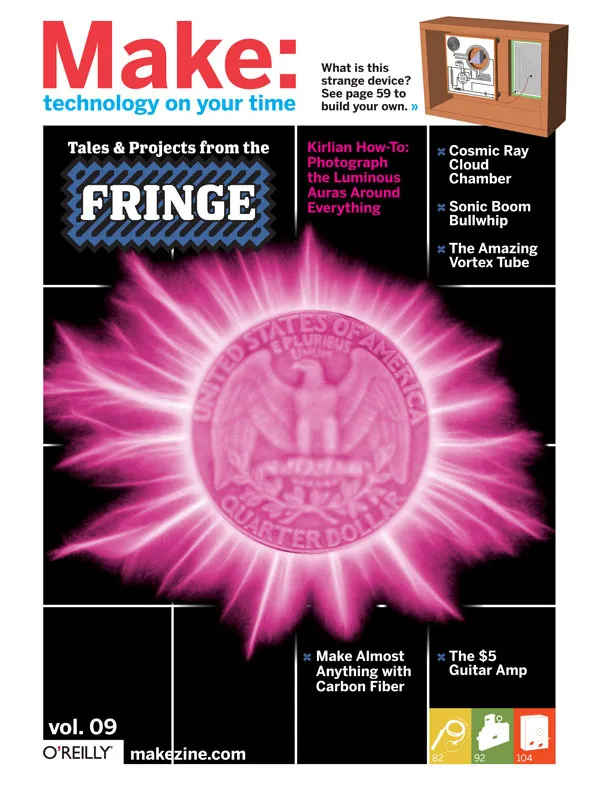
Project: The $5 Cracker Box Amplifier
Read this article in MAKE:
09: Fringe, Page 104.
To get MAKE, subscribe or purchase single volumes.
Small box, big sound.
Download Sample PDF of this article (excerpt).
Media
Multimedia content for this article:
Monte Cristo
Download now: MPEG
Bolivar
Download now: MPEG
Partagas
Download now: MPEG
Out of Milk and Butter Blues
Download now: MPEG
Links
- Schematic PDF
- Headphone Amplifier
- Mini Bench Amp
- Home-built frequency division bat detector
- National Semiconductor
- Solarbotics
- runoffgroove.com
MAKE: Noise — Discuss this article
You must be logged in to post a talkback.[ Display main threads only] [ Oldest First]
Showing messages 1 through 116 of 116.
- sound trouble
You must be logged in to reply.
MY CIRCUIT IS CORRECT (I HAVE CHECKED IT WITH OTHER BREADBOARDS) BUT THE SPEAKER I USE IS A 4 OHM 3 WATT......WHEN I PLUG THE GUITAR IN AND PLAY THE NOTES COME OUT AS SHORT CRACKLES IN THE PITCH OF THE NOTE...I TOOK THE ic FROM A RADIO AND I DONT KNOW IF I MAY HAVE OVERHEATED IT WHILE DESOLDERING IT? ALSO WHAT DOES THE IMPEDENCE ON A SPEAKER CHANGE AUDIO WISE?Posted by Solder boy on May 28, 2008 at 23:23:33 Pacific Time
- sound trouble
You must be logged in to reply.
I recommend taking out the chip and replacing it with one purchased from Radio Shack or Digikey. An IC socket is also a good idea.Posted by EdV on May 29, 2008 at 09:54:58 Pacific Time
- sound trouble
You must be logged in to reply.
THANK YOU THAT HELPS ALOT.......ALSO DO U KNOW WHAT THE SPEAKER'S IMPEDENCE HAVE TO DO WITH THE CIRCUITPosted by Solder boy on May 29, 2008 at 16:29:02 Pacific Time
- sound trouble
You must be logged in to reply.
The impedance "is sort" of related to the power the amp can deliver and power the speaker can handle. You may want to get an impedance matching transformer from Radio Shack.
Here is the wiki article:
http://en.wikipedia.org/wiki/Impedance_matching
Posted by EdV on May 30, 2008 at 05:27:00 Pacific Time
- oops!--->sound trouble
You must be logged in to reply.
Loudspeaker amplifiers
Modern solid state audio amplifiers do not use matched impedances, contrary to myth. The driver amplifier has a low output impedance, such as < 0.1 ohm, and the loudspeaker usually has an input impedance of 4, 8, or 16 ohms, which is many times larger than the former. This type of connection is impedance bridging, and it provides better damping of the loudspeaker cone to minimize distortion.
Of course this is from wikipedia so who knows. It does have the ring of truth to it though. You may also want to read the LM386 datasheet and app notes.
"The myth comes from tube audio amplifiers, which required impedance matching for proper, reliable operation. Most of these had output transformer taps to approximately match the amplifier output to typical loudspeaker impedances."
Posted by EdV on May 30, 2008 at 05:31:19 Pacific Time
- oops!--->sound trouble
You must be logged in to reply.
Thank you for helping me, this amp is awsomePosted by Solder boy on May 30, 2008 at 10:06:13 Pacific Time
- oops!--->sound trouble
You must be logged in to reply.
Rock On!Posted by EdV on May 30, 2008 at 10:26:45 Pacific Time
- oops!--->sound trouble
You must be logged in to reply.
Its finished now but i was wondering how long is the battery life because it seems that the weaker the battery get the more distorted the sound is?Posted by Solder boy on June 01, 2008 at 12:26:01 Pacific Time
- Speaker Question
You must be logged in to reply.
Hello, this is my first attempt at something like this. The speaker I have is 32 ohm, 1watt. Could someone explain what, if any, changes I would need to make to have this speaker work?
Thank You.Posted by Jm7o on May 07, 2008 at 18:26:41 Pacific Time
- Has anyone thought about.....
You must be logged in to reply.
Could this project be modified into a talkbox or as a preamp??
DanPosted by M42 on February 22, 2008 at 13:52:02 Pacific Time
- Crank it up
You must be logged in to reply.
I just finished building this amplifier using the body of an old 1953 Crosley radio as an enclosure and a hand-cranked flashlight as an alternative power source. It sounds great! Check it out.Posted by kuiphoff1006 on January 13, 2008 at 17:33:03 Pacific Time
- Little Gem
You must be logged in to reply.
I just finished my amp, and I'm pretty impressed with the circuit. It's relatively simple (even though it took me a few tries to get it right) and has a great distortion sound.
However, I'm not getting a really clean sound even with the gain down. I'm using a 5k pot for gain and a 25k rheostat for volume. If anyone has any ideas, let me know.
Anyway, here's a my amp on Flickr.Posted by kritarchist on September 01, 2007 at 21:09:30 Pacific Time
- Done and Amped!
You must be logged in to reply.
Just finished mine as a gift for someone. This project rocked. Relatively simple with a great payoff at the end. Shout outs to 'cairn' below for posting the breadboard pic. It totally helped me in validating the schematic. Pictures of my completed PopSecret Amp on flickr.Posted by nitdoggx on August 14, 2007 at 19:37:49 Pacific Time
- distortion !
You must be logged in to reply.
I just build this little amp and the sound seem to pass through but I also get a huge amount of distortion and noise coming from it.. anybody else got that ? I triple checked my connections and everything .. playing with the pots don't help much...
anyone can help me ?
thanksPosted by phil.savard on August 11, 2007 at 13:33:12 Pacific Time
- Cassette Tape Player hacked into an Amp
You must be logged in to reply.
I have discovered that removing the play head from a cassette tape player and splicing in a microphone or piezo pickup makes for a pretty sweeet little practice amp.
video link:
http://vids.myspace.com/index.cfm?fuseaction=vids.showvids&friendID=213486278&n=213486278&MyToken=af4ec180-e011-41e2-8613-a0f9b8004d50
or
myspace.com/cbgmpls and click on video
Hasta amigos,
Ed VogelPosted by EdV on July 21, 2007 at 06:33:22 Pacific Time
- Cassette Tape Player hacked into an Amp
You must be logged in to reply.
I took apart some computer speakers and used to guts to make a practice amp---in a pinch you can use the input cable from the speakers put a 1/8 to 1/4 TRS adaptor on it and plug in your guitar. I was amazed on how good it sounded thru my acousticPosted by ajamm on December 07, 2007 at 11:04:02 Pacific Time
- Picking up radio signals
You must be logged in to reply.
I just finished building my amp, and as soon as I turned it on(without anything connected to it)it started picking up radio stations When I turned the gain up or down, it switched between a spanish station and a country station, albeit with alot of static. Does anyone know whats up? I tried plugging in a piezo element, it didn't pick up any vibrations unless I tapped ti really hard. Someone please help 'cause my $5 amp cost more like $25.Posted by zcx_f on July 20, 2007 at 19:16:46 Pacific Time
- Picking up radio signals
You must be logged in to reply.
Sorry to hear about your difficulties. I am guessing you might want to touch up solder joints around the input pins of the LM386.
Good luck,
Ed VogelPosted by EdV on July 21, 2007 at 06:16:23 Pacific Time
- Photos of working amp!
You must be logged in to reply.
Posted by JeffBetts on July 15, 2007 at 16:06:01 Pacific Time - Photos of working amp!
You must be logged in to reply.
Congratulations! thanks for the great pics!Posted by EdV on July 16, 2007 at 05:34:23 Pacific Time
- Photos of working amp!
You must be logged in to reply.
Congratulations! thanks for the great pics!Posted by EdV on July 16, 2007 at 05:34:02 Pacific Time
- Photos of working amp!
You must be logged in to reply.
Link to photos
Repost photosPosted by JeffBetts on July 15, 2007 at 16:09:42 Pacific Time
- modifications (hi-z input, extra gain, FX loop, headphone out , LED)
You must be logged in to reply.
Hi everyone... I have some comments and questions.
The Ruby amp has a buffered input. Supposedly this increases the input Z (the LM386 chip has a very low input Z otherwise). I assume this will make the amp sound better/louder.
Can someone post a simple wiring diagram or explain what parts of the Ruby circuit you could transplant into the Crackerbox (and where to wire them in) to add an input buffer?
This amp sounds especially bitchen if you plug your guitar into an MXR distortion+ pedal and then into the amp, and turn up the gain.
So I might try making a 2nd circuit as a preamp and see how having 2 stages of gain sounds.
Will simply plugging the speaker out of amp #1 into the input of amp #2 blow it up?
Any idea how to add a simple effects loop (where to wire the out to effects/in from effects jacks, and any additional modifications necessary) ?
How do you add a headphone jack and have it bypass the speaker when headphones are plugged in?
Is there a good wiring diagram for how to wire in a power LED?
What is the total load on this circuit? I am trying to find out how much current this amp uses so if I build 2 and want to power them off one wall wart, I know how many mA the power supply needs to supply.
Thanks!
Posted by Ap'l on June 13, 2007 at 09:22:10 Pacific Time
- Finished!
You must be logged in to reply.
Actually, I made the Ruby amp which is slightly more complex than the Little Gem ("enhanced" according to runoffgroove.com). I used an old wall-mount Muzak speaker for the box. Looks and sounds great! Also made my own PCB. I was unable to locate the 1k gain pot called for on the Ruby page, so I just used the 5k. Construction photos here.Posted by guero on June 04, 2007 at 12:47:27 Pacific Time
- Lots of help needed
You must be logged in to reply.
Ok, I have never attempted anything like this before. The closest experience I have with anything like this is fixing a pair of Sony headphones (basically soldering loose wires back) and replacing the battery of a game boy cartridge. I think that for a beginner like me, a little more detail is required instructions wise. I consider myself pretty handy with just about anything, but having never done anything on a component level such as this, I need a little more help than others. I'm, talking step by literal step as far as where does everything need to go on the board and pretty much which way is up? I'm lost after a few steps. Please help. Anything someone could tell me would be most assuredly helpful.Posted by dragen on May 09, 2007 at 20:03:11 Pacific Time
- Lots of help needed
You must be logged in to reply.
http://www.flickr.com/photos/54804764@N00/401719542/
This helped so much when I made mine, I didn't crack the magazine aside for getting the parts list.Posted by NegativeTom on May 09, 2007 at 22:07:23 Pacific Time
- bone crushing power
You must be logged in to reply.
http://i27.photobucket.com/albums/c171/stefanieandtom/PC310002.jpg
Finished the build (my first time putting anything like this...the only things I have soldered before were guitar jacks). The only difference from the original design is it has 2 .047uf capacitors instead of the .01. The speaker is a 10"er taken out of some older marantz that I parted out.
Stoked on how it all turned out and am going to order the parts to make some different little amps (one with a larger cap for bass and then one with two bridged chips).
Posted by NegativeTom on May 08, 2007 at 01:21:10 Pacific Time
- LED
You must be logged in to reply.
Can anyone tell me how to get an led to work in this circuit? I can't seem to make it work. I think I bought an LED that needs more volts than the 9 volt can give.
Thanks in advance!Posted by johnransom on April 30, 2007 at 14:23:05 Pacific Time
- LED
You must be logged in to reply.
http://www.blackoctopus.org/crackerboxamp/IMG_2276.JPG
I'm not sure if this is clear enough for you to see where I put my LED. If you don't have an LED with a built in resistor like the one in the picture you'll need to place one before the LED or you'll blow your LED out. A 270k should do it --Posted by TentacleJoe on June 13, 2007 at 16:39:12 Pacific Time
- LED
You must be logged in to reply.
tell me abt LedPosted by amitvarma on May 31, 2007 at 08:33:14 Pacific Time
- Capacitor Voltages
You must be logged in to reply.
what voltages do the capacitors need to be?Posted by technoman2894 on April 30, 2007 at 11:56:22 Pacific Time
- Five dollars!
You must be logged in to reply.
I went to radio shack to get the parts for this, all what was used in the article. Total 43.09!!!!! Hurumph. Five dollars my rear.Posted by Nickzeke on April 21, 2007 at 18:43:00 Pacific Time
- Five dollars!
You must be logged in to reply.
I bought the parts for mine at Goldmine Electronics. They had a minimum order of $10.. so I bought enough parts for two.
They didn't have 1/4" jacks or 25 ohm rheostats, but RS has those at fairly low prices.
Radio Shack sucks for buying small electronic parts. Go with an online vendor.Posted by BlueNinja on May 24, 2007 at 11:33:30 Pacific Time
- Five dollars!
You must be logged in to reply.
I just did a quick shopping list on radioshack.com for the parts and I come up with $16.41 minus wire, and a 9volt battery. What else did you buy =)Posted by TentacleJoe on April 23, 2007 at 17:48:12 Pacific Time
- Five dollars!
You must be logged in to reply.
APosted by Nickzeke on April 23, 2007 at 20:57:20 Pacific Time
- Five dollars!
You must be logged in to reply.
A headphone adapter, and wire. Total for these two parts. 10$Posted by Nickzeke on April 23, 2007 at 20:56:55 Pacific Time
- Redemption Song
You must be logged in to reply.
Alas, a glorious resolution to my schematic confusion. After visting National Semiconductors site to take a look at the tech specs for the 386 chip, I noted, to my complete chagrine, I had incorrectly assumed the ordering of the pin numbers on the chip. The right side of the chip is numbered 8,7,6,5 from top to bottom and not 5,6,7,8 as I had intuited. I've repented my evil ways, and tonight set my guitar singing through the project! If anyone else needs a hand, I'd be happy to help. Keep on rockin' in the free world...Posted by teslaphile on April 20, 2007 at 23:58:53 Pacific Time
- Redemption Song
You must be logged in to reply.
Hi, glad you git it worked out. So this is sort of a stupid question but if I had a SPST switch for on off (to obviously save the battery)and I put it in in the positive lead from the battery would it keep it from draining when turned off? Also, the 5k potentiometer (not the Rheostat) clicks off as if it is actually breaking the circuit (which I'd think would save the battery) but not the case. I've left the battery in for about 5 days & now it's dead (I didn't leave my cord plugged in).Posted by johnransom on April 29, 2007 at 15:42:31 Pacific Time
- Redemption Song
You must be logged in to reply.
Hi, glad you git it worked out. So this is sort of a stupid question but if I had a SPST switch for on off (to obviously save the battery)and I put it in in the positive lead from the battery would it keep it from draining when turned off? Also, the 5k potentiometer (not the Rheostat) clicks off as if it is actually breaking the circuit (which I'd think would save the battery) but not the case. I've left the battery in for about 5 days & now it's dead (I didn't leave my cord plugged in).Posted by johnransom on April 29, 2007 at 15:42:20 Pacific Time
- Schematicus Confusiousus
You must be logged in to reply.
I'm on my fourth try with this project with the only result being an overheated IC chip and minor mental irritation. I've compared the Make magazine schematic to the the little-gem-layout pictured at www.flickr and seem to find some discrepancies.
Make's schematic shows the center terminal of the 5K pot connected to the #8 pin on the chip while the little-gem-layout shows the connection going to the #5 pin. Make shows the #5 pin connected to the 220? resistor and 0.047 capacitor and running out to the 25? rheostat while the little-gem sketch shows this connection coming out of the #8 pin.
Furthermore, Make shows the #6 pin connecting to +9V while the little-gem shows no connection. Lastly Make depicts no connection to the #7 pin, yet the little-gem indicates a connection to +9V.
I'm confused. Am I hallucinating? Can someone who's successfully put this together offer some guidance?Posted by teslaphile on April 20, 2007 at 00:08:38 Pacific Time
- breadboard
You must be logged in to reply.
Does anyone have a picture of this circuit working properly on a breadboard? I need some direction I believe.Posted by johnransom on April 18, 2007 at 01:27:29 Pacific Time
- breadboard
You must be logged in to reply.
http://www.blackoctopus.org/crackerboxamp/IMG_2269.JPG
http://www.blackoctopus.org/crackerboxamp/IMG_2276.JPGPosted by TentacleJoe on April 23, 2007 at 17:37:27 Pacific Time
- I just built mine...
You must be logged in to reply.
First off, this is the first electronics thing I've ever made and so it was pretty awesome to have it work first try.
It sounds WAY better than I expected it to, I'd even go so far as to say that this would be a great starter amp for anybody. Just because I'm so pleased it works I'm probably going to spend more time playing this than my $2500 all tube peavey stack for quite a while.
The volume levels are more than adequate for an apartment building.
Mine also manages to pick up a blues radio station, only fitting I would say.
Now I'm going to lookup some reverb circuts.Posted by clevijoki on April 15, 2007 at 23:28:52 Pacific Time
- I just built mine...
You must be logged in to reply.
Does anyone have a picture of their set up on a breadboard? This is supposed to be really easy but without any prior knowledge of electronics, it's a bit difficult I'm finding. Thanks.Posted by johnransom on April 18, 2007 at 00:40:35 Pacific Time
- I just built mine...
You must be logged in to reply.
Does anyone have a picture of their set up on a breadboard? This is supposed to be really easy but without any prior knowledge of electronics, it's a bit difficult I'm finding. Thanks.Posted by johnransom on April 18, 2007 at 00:40:16 Pacific Time
- USB external power source
You must be logged in to reply.
If you want to add an alternative (non-battery) power supply to this low power project, use the USB port of your computer or laptop. The ready availability of computers, and the portability of the laptop, provides an opportunity to use your device without a separate battery supply. The USB port power output is rated at 5V and 500 ma (about 2 watts), that is more than sufficient for low power projects, such as this one.
I have to inject a strong warning here: do not attempt this USB power source unless you are familiar with the general principles of power supplies and the set up of a USB port, whose specifications you can find on the web. While you wont hurt yourself with this low voltage project, you could potentially damage your computer or your amplifier project. The usual disclaimer: I will not be responsible for damage incurred.
I modified a USB cable by cutting off one end (the end that would normally connect with a USB device). I soldered the red wire (+5V) and black wire ( -) to a power plug. I cut short the other two wires, that are normally used for the USB signal, and carefully stripped back the braided wire shield and foil shield to avoid a short circuit. The arrangement of the red and black wires to the plug depends on the orientation of power jack that connects to the amplifier circuit. In this case, I used a panel-mount coaxial power jack with switch from radio shack (about $3.00). The utility of this jack is that both the battery and the USB external power supply can be wired to this device. The switch built into the jack automatically detects (moves) its contacts so that either the battery or the external USB plug supplies the power to the project thereby avoiding connecting the two power supplies together. As mentioned above with respect to the wiring of the USB plug, this particular jack required that I solder the red wire of the USB to the sleeve and black wire to the tip connectors (the reverse of most power jacks/plugs) so that the polarity was correct for input.
Going further: compared to the voltage requirement of the L386 audio amplifier (4 to 12V DC), the L386N-4 suggested in the article requires 9 to 18V DC input. Therefore, the voltage output of a USB port would not be sufficient. However, this output can to boosted to a higher level by a DC to DC converter. This voltage booster device could be harvested from off-the-shelf items such as cellular phone chargers that can be used with USB ports. Another alternative is to buy a small DC to DC converter suitable for mounting on the circuit board. Such solid-state devices are available. For example, I obtained the Texas Instruments device (model number: PT5541N). It accepts an input as low as about 4.5V and boosts the output to 12V DC. It costs about $10, but TI might be willing to provide a sample if you sign up on their website. The output of the USB power cable would then be boosted to 12V on the circuit board and would be suitable for driving this L386N-4 audio amplifier. Bear in mind that, even though the voltage is increased, it is important to limit the total power output of the USB port to 2 watts.
Posted by MarthaMan on April 14, 2007 at 19:36:53 Pacific Time
- Too Quiet
You must be logged in to reply.
I finally finished my mini-amp last night, and I tested it today with a friends electric-acoustic guitar, and it was very quiet. The guitar alone was much louder than the amp, but it still did work. I'm thinking that an electric-acoustic guitar would not work as well with this amp, and I have not tested with an electric guitar yet. I tryed splicing in an MP3 player and it works very well. Has anyone else had this problem with an electric-acoustic guitar?Posted by bugsingelyn on April 11, 2007 at 15:30:19 Pacific Time
- Green Tea
You must be logged in to reply.
I built another one and put it inside a green tea box. This time I included a headphone jack. The speaker is located on the top of the box.
http://www.blackoctopus.org/crackerboxamp/green-tea/Posted by TentacleJoe on April 10, 2007 at 21:59:34 Pacific Time
- How can I use this 1-ohm speaker?
You must be logged in to reply.
I found a very cool Muzak wall speaker at a yard sale -- it's enclosed in a nice wooden box already, with lots of room for the amp circuitry. Only problem is, I measured it & it seems to be only 1 ohm. Would this work, or do I need to add/substitute a resistor or something?Posted by guero on April 05, 2007 at 19:51:10 Pacific Time
- How can I use this 1-ohm speaker?
You must be logged in to reply.
Oh yeah, should mention that there is a transformer thingy attached to the speaker. I measured the 1 ohm across the speaker contacts, NOT the leads going into the transformer.Posted by guero on April 05, 2007 at 19:54:31 Pacific Time
- never mind
You must be logged in to reply.
I disconnected the transformer & now the speaker measures 8 ohms, so i answered my own question, sorry...Posted by guero on April 05, 2007 at 20:08:20 Pacific Time
- Tweaking the box
You must be logged in to reply.
This is my first project following a schematic and it has been a pleasant brain squeeze. I have a few questions: 1) Does it affect the circuit if the 100 uf capicator is located at the end of the circuit (on the far end of the 386 audio amplifier)? 2) My amp appears to be working, but the volume is low. I have only been able to test it by splicing the wires from an old set of walkman headphones and playing a portable CD player. The sound was clear, but soft. What can I do to pump up the volume?Posted by Stillwater on April 03, 2007 at 22:47:07 Pacific Time
- 2x12 Madness
You must be logged in to reply.
Wow this little thing is amazing. I just spent the night playing it through my 2x12 cabinet and its pretty damn loud!
I stuck mine in a $2.00 project enclosure from RadioShack and printed some silly decals on my laser printer -
http://www.blackoctpus.org/crackerboxamp/ld.jpg
Soundclip:
http://www.blackoctopus.org/crackerboxamp/make-09-crackerbox.mp3Posted by TentacleJoe on April 02, 2007 at 20:24:51 Pacific Time
- 2x12 Madness
You must be logged in to reply.
Typo on the image link.
http://www.blackoctopus.org/crackerboxamp/ld.jpgPosted by TentacleJoe on April 02, 2007 at 20:26:15 Pacific Time
- couple of questions
You must be logged in to reply.
i'm making the speakers at the moment and i'm actually going to use it as speakers for my computer or for anything else. and i was wondering if i could have two but wasn't too sure how i would go connecting the two speakers and on top of that i was looking for a schematic of how to make a subwoofer. if anyone could lead me in the right direction that would be great. thanksPosted by shem19 on March 25, 2007 at 15:09:49 Pacific Time
- Where to Find A Rheostat
You must be logged in to reply.
Hi all. I am trying to make this amp, but am having trouble with the rheostat. I found one on DigiKey, but it was $25! Any ideas on where I can find one on the cheap, or where I could scavenge one?Posted by LoopUniverse on March 14, 2007 at 09:47:32 Pacific Time
- Where to Find A Rheostat
You must be logged in to reply.
I picked one up at RadioShack, for all of 1.75 or so...
http://www.radioshack.com/product/index.jsp?productId=2062299&cp=2032058.2032230.2032275&parentPage=family
Should work.Posted by jlel12 on March 14, 2007 at 14:56:06 Pacific Time
- Where to Find A Rheostat
You must be logged in to reply.
i'm confused, what is it that you define as a rheostat??
i can find only potentiometers and not 25ohm ones, most are pretty much higher value.
could i use some potentiometer or should i endeavour in ordering online for a specific rheostat???
thanks!Posted by zanshin on March 26, 2007 at 02:45:53 Pacific Time
- Inverting vs. Noninverting
You must be logged in to reply.
I've been having some trouble with the amp. I bought some parts from a surplus store - so I can't be sure that they work properly. Anyway, I set up the circuit on a protoboard as in the schematic and when I plug my guitar in I get a constant noise that I can modulate with the pot. If I listen carefully, I can hear some change in the pitch when I strum. After taking apart and putting together the circuit many times I have the same problem. I noticed that I could take out the 10 Ohm resistor and 0.047 capacitor and undground pin 4 on the op amp without changing the sound coming out of the speaker. I then decided to move the input and 0.01 capacitor from pin 2 to pin 3 and voila - it works. Any idea why this is?Posted by eddawg13 on March 13, 2007 at 20:12:21 Pacific Time
- Inverting vs. Noninverting
You must be logged in to reply.
Well, I must have had a wire in the wrong place or not contacted properly in the protoboard. The circuit now works as advertised. Instead of using a cracker box I used an old fossil wallet tin. It works great. I might splice a red LED into it to show its on. This was a great project to work on. Thanks Ed!Posted by eddawg13 on March 18, 2007 at 17:08:14 Pacific Time
- Inverting vs. Noninverting
You must be logged in to reply.
Where would you add the LED to the circuit?Posted by TentacleJoe on March 19, 2007 at 18:37:17 Pacific Time
- Inverting vs. Noninverting
You must be logged in to reply.
Not sure yet. I was thinking just after the on/off switch. I'll let you know if I get to it. I've been having so much fun with the sound from the amp that I haven't given it too much thought. I need to dig up some AC/DC tunes - the distortion is just right. Now I want to make some pedals.Posted by eddawg13 on March 21, 2007 at 10:34:58 Pacific Time
- Inverting vs. Noninverting
You must be logged in to reply.
Yeah I still have mine on a solder-less board because I've been enjoying playing it. Its so great to have something so tiny that doesn't require too much effort to hook up and be able to play in my living room with the door open without bothering the neighbors =)Posted by TentacleJoe on March 21, 2007 at 19:14:04 Pacific Time
- Inverting vs. Noninverting
You must be logged in to reply.
You are welcome. Those fossil tins look mighty sharp!Posted by EdV on March 19, 2007 at 06:20:26 Pacific Time
- Is the 25K Potentiometer Overkill?
You must be logged in to reply.
My son and I built this project over the weekend. Had a blast and it works great. We used a 16 ohm speaker that was laying around and it still sounds pretty good (will be traded in for a 8 ohm later).
Anyway, when I turn up the gain knob (25K potentiometer), I get about a quarter turn (or less) and it's maxed.
I was thinking of trying a 10K instead. Anyone else experience this with their circuit?Posted by nudeanaglyphs on March 12, 2007 at 18:27:10 Pacific Time
- Is the 25K Potentiometer Overkill?
You must be logged in to reply.
Gak. I'm was confused. I meant the 5K potentiometer.
Posted by nudeanaglyphs on March 12, 2007 at 18:43:35 Pacific Time
- Question about speakers...
You must be logged in to reply.
Posted by jlel12 on March 12, 2007 at 16:02:45 Pacific Time
- Question about speakers...
You must be logged in to reply.
Hah, whoops...A little overenthusiastic with the enter button there...
Anyway, I posted this on the forums but didnt get any reply - thought I'd try here.
Hello,
I'm trying to build the Crackerbox Amp (Make Vol. 9) for my little sister. So far, I've procured most of the components, with the notable exception of the speaker. I have some options for speakers: these include 1) a 2-inch, 8-ohm, .1w no-name speaker with the cone partially dissasociated from the speaker frame, 2) a 3-inch, 4-ohm, .63w no-name speaker (in better condition), as well as the woofer and satellite speakers from a broken set of Altec-Lansing XA3021 computer speakers. The spec sheet for these is here:
http://www.alteclansing.com/downloads/LAT/XA3021%20sell%20sheet.pdf
As near as I can tell from this, the the satellites are each 4-ohm, 4w speakers and the woofer is a 4-ohm, 14w speaker (Not completely sure - tell me if i'm wrong).
My question is, which of these (if any) should I use? As far as sound quality goes, I would prefer to use the Altec-Lansing speakers, either both satellites, or a satellite and the woofer (maybe with a crossover...hmm). However, from what I've seen, there's two problems with this. One, I would need to run the speakers in paralell in order to get the 8-ohm impedance that the amp circuit is designed to accomodate. Secondly, it seems to me that the higher wattage required/accepted (I assume the number on the speaker is the maximum supported wattage) by the Altec-Lansings would be too much for the Crackerbox Amp circuit - if nothing else, the speakers are much bigger, with much bigger magnets than the speaker used in the magazine.
Anyway, thanks for bearing with me - my knowledge of electrical theory is (obviously) limited, and I appreciate any help or suggestions you all may have.
Thanks,
J.L
(Edit) Ehm...I just took one of the satellites and tapped the poles with a 9-volt battery (the powersource for the Crackerbox Amp) - the speaker cone moved pretty far and made a pretty loud *click*...Granted though, this was just one speaker, and I'm not sure how loud I should expect it to be. Another thought - could I increase the impedance of the speaker without attaching a second one in series?Posted by jlel12 on March 12, 2007 at 16:03:51 Pacific Time
- Question about speakers...
You must be logged in to reply.
Thought I'd throw this in - nothing to do with my question, but kinda interesting. I just finished soldering up the amp as best I could, plugged in the battery and turned it on. Doesn't work worth a damn as an amp, but it does pick up radio signals - 'gain' dial controls volume, 'volume' dial *seems* to control frequency. Bizzare...whatever, I'll fix it tomorrow.Posted by jlel12 on March 13, 2007 at 19:57:51 Pacific Time
- Question about speakers...
You must be logged in to reply.
As far as picking up radio signals - I had the same problem. Replacing all the wires to/from the rheostat, potentiometer, input and speaker with shielded wire (just cut up a cheap 6' guitar cable) made it MUCH quieter and the radio signals went away.Posted by Ap'l on June 13, 2007 at 08:58:42 Pacific Time
- Something Isn't Right...
You must be logged in to reply.
Ok, we built the amp following the directions. Our amp is super quiet however. Also we can't get it to work with the half inch jack for the guitar. If we splice in a source like a mp3 player it plays. However if we plug the guitar into the jack or even splice the guitar in there is no sound. This is our second try at building this thing. Our first attempt ended up with the circuit built horizontally mirrored to the IC. I really want this thing to work. It's very frustrating :(Posted by Doitle on March 10, 2007 at 23:36:48 Pacific Time
- Something Isn't Right...
You must be logged in to reply.
what kind of guitar is it?
i ask because most guitars are active, meaning they have a battery in them that provides current to the amp, allowing them to be amplified.
However, some, like most bass guitars, are passive, and require a little current from the amp.
you can supply a small current from the cracker box by pulling up the input from the instrument with a resistor to the positive power supply, but you want to make sure you don't damage the guitar!Posted by navaburo on April 07, 2007 at 20:55:56 Pacific Time
- possible solution
You must be logged in to reply.
what kind of guitar is it?
i ask because most guitars are active, meaning they have a battery in them that provides current to the amp, allowing them to be amplified.
However, some, like most bass guitars, are passive, and require a little current from the amp.
you can supply a small current from the cracker box by pulling up the input from the instrument with a resistor to the positive power supply, but you want to make sure you don't damage the guitar!Posted by navaburo on April 07, 2007 at 20:55:05 Pacific Time
- possible solution
You must be logged in to reply.
what kind of guitar is it?
i ask because most guitars are active, meaning they have a battery in them that provides current to the amp, allowing them to be amplified.
However, some, like most bass guitars, are passive, and require a little current from the amp.
you can supply a small current from the cracker box by pulling up the input from the instrument with a resistor to the positive power supply, but you want to make sure you don't damage the guitar!Posted by navaburo on April 07, 2007 at 20:54:53 Pacific Time
- Something Isn't Right...
You must be logged in to reply.
I had the same problem when I built my amp. I noticed that the speaker would slightly "pop" when I just touched my cord plug to the springclip in the speaker jack. As long as the two metal pieces touched, everything worked fine, but when the cord plug was depressed all the way, the two metal pieces separated as designed. I simply soldered a short wire between the two lugs of these two pole pieces and everything worked great. You might want to try the same and see if this fix happens to work for you. Good luck.Posted by chuckwinn on March 12, 2007 at 21:04:22 Pacific Time
- $5 amp
You must be logged in to reply.
1st off ... this amp ROCKS, my roommate is laughing his a$$ off cuz im playing thru a cracker box rather than the $1,200 marshall stack we have!
2ndly .. i wasnt sure why a rheastat was needed, but i went out and got one ($3.99 at the shack) .. everythign else i had on hand...so it was actually a $4 amp !!!Posted by Mubo on March 09, 2007 at 14:16:00 Pacific Time
- Troubleshooting
You must be logged in to reply.
Does anyone have a suggestion about an amp that is distorted even with the gain down low. I built the project on a solderless board first. Worked perfectly. Had a clean sound or a crunchy distortion depending on the gain and main volume relationship. Now after moving over to the soldered board. I get either distorted or extreme distortion, depending on the gain. No clean possible. I'm happy it works, but, you know...I'd like it to be the best cracker box amp it could be.
Thanks.Posted by megacreon on March 06, 2007 at 12:57:49 Pacific Time
- Amp Speaker & Cabinet
You must be logged in to reply.
I found an old pair of computer speakers in a box in the garage that I couldn't remember whether or not I had kept them or threw them out. I took the screws out of the back and saw that the speaker was 8 ohms - perfect for the Little Gem Cracker Box amp. In addition, it looked as though there was the perfect amount of space for the board, switches and connections, so took the 2nd speaker from the pair and used it for my amp enclosure. I used the battery hatch on the back to hold the 9-V battery. It fits nicely in the box. I may upgrade the chip to the version that can hold 19-V as Ive got room for another 9-V in the space. Old, surplus computer speaker systems (flat screen monitors typically come with their own speakers now) can be a great source for the a speaker and the cabinet! The whole thing turned out great. The sound is pretty damn good from this Little Gem. Here is the link to photos: http://www.flickr.com/photos/7106966@N05/Posted by chuckwinn on February 26, 2007 at 20:41:08 Pacific Time
- my circuit layout
You must be logged in to reply.
Since a few people seem unfamiliar with circuit schematics, I drew up the layout that I used on the suggested Radioshack project board. I put it on my Flickr page. Take a look at it if you're having trouble figuring out where the components go.
If I made any mistakes in my drawing, please let me know. I built the amp using this layout and it works great!
Posted by cairn on February 25, 2007 at 01:06:24 Pacific Time
- my circuit layout
You must be logged in to reply.
From reading the postings there seems to be confusion over whether your drawing is accurate. Have you had any feedback to improve your drawing or is your drawing accurate and people are just being careless in building it?Posted by amdamgraham on April 27, 2007 at 08:25:35 Pacific Time
- my circuit layout
You must be logged in to reply.
Thanks for the Flickr drawing -- it helped us figure out several places that we had incorrect connections.
Unfortunately the thing still doesn't work; we're bailing on this one after getting in for $30 in parts, a week of effort, and a first-name basis with Radio Shack store personnel. Seemed like a simple circuit and a way to advance my son's interested in electronics, but he doesn't seem so enthused now. Ah, if only Heathkit were still around...Posted by jacl on March 04, 2007 at 13:31:38 Pacific Time
- my circuit layout
You must be logged in to reply.
Thanks this drawing was really great and a LOT clearer. We followed it, got it all put together, but neither of our amps worked. One question, it looks like the chip is connected in 3 points to the positive and negative proto rows. Should we do that? Otherwise, maybe it was messy soldering, or something. But we're really appreciative; at least we get how it SHOULD WORK! THANKS! Corina FastwolfPosted by CorinaFastwolf on February 25, 2007 at 21:40:53 Pacific Time
- my circuit layout
You must be logged in to reply.
Yep, pins 3 and 4 go straight to ground and pin 6 goes straight to positive. For troubleshooting or playing around, you can also substitute a fixed resistor between pins 1 and 8 instead of the 5K pot (try 1k to start) and you can get rid of the rheostat and connect the back end of the 220 cap to speaker positive. That would put you at full volume though so I'd only do this temporarily.
I built a few of these amps now and the first two didn't work right away. The first one, I forgot to connect pin 6. The second one, well, I hooked it up to the battery with alligator clips and it started to smell funny and it didn't work. The LM386 was getting really hot. I disconnected it and looked over the whole circuit and everything was good. I took a break, went to eat something, came back and noticed I had hooked up the battery backwards! Hooked it up the right way and it worked fine. Sometimes it can just be a really dumb mistake.
Make sure all the components are in the right places and that they are oriented correctly (especially for the IC and the electrolytic caps). If everything looks good, then take out your meter and make sure all the right connections are working and that there aren't any shorts. Good luck!
Posted by cairn on February 25, 2007 at 23:52:48 Pacific Time
- my circuit layout
You must be logged in to reply.
WOOOOW! YOU ARE A TOTAL GENIUS! Our speakers finally, finally work! I made mine in a pink Valentine heart shaped chocolate box with a big old Cupid on the front and it looks so great! My boyfriend made his in an old cabinet for a reel to reel tape deck, and his is a LOT louder...maybe just better acoustics?
Anyways, you're drawing and advice really helped and we're really greatful and we've had big grins on our faces ever since. Thank you thank you !Corina FastwolfPosted by CorinaFastwolf on February 27, 2007 at 22:14:28 Pacific Time
- Crackerbox Amp
You must be logged in to reply.
OK, making this amp is making me crackerboxed! We followed instructions until 1G, but don't know how to proceed. It's like the instructions jumped off a cliff. We can't read the schematic, (but the instructions refer us instead to the photos) and the photos and drawn illustrations seemed flipped, ie where the - and + are is opposite. Is there anyway to get a drawing of where everything connects to the circuit board? For example, where do the 220 and 100 capacitor go? And the wires to the vol. and gain knobs?
If you need to be able to read schematics to follow these plans, that should be clearly specified.Also we agree, it's not a $5 amp, for us it cost $23, and if we can't follow the instructions, it's just wasted : (
We want to do this we really do, but we don't know how to proceed Thanks CorinaFastwolf PS we live each day like it's our rockin last.Posted by CorinaFastwolf on February 24, 2007 at 14:24:58 Pacific Time
- Crackerbox Amp
You must be logged in to reply.
Take a look at the perf-board layout at http://runoffgroove.com/littlegem.html. It's for the same circuit (the "Little Gem"), although it's built on perf-board without rails, you should be able to figure it out no problem from the diagram on that page. Good luck!Posted by cairn on February 24, 2007 at 23:31:40 Pacific Time
- Crackerbox Amp
You must be logged in to reply.
I agree, please post a birds eye view, as I don't know what I'm doing and really want to finish this up!Posted by mIiwaukee on February 24, 2007 at 15:07:24 Pacific Time
- Made:
You must be logged in to reply.
I built it, but I decided I wanted a better cabinet than a cardboard cracker box: pics herePosted by chickenDelicious on February 23, 2007 at 16:01:24 Pacific Time
- Made:
You must be logged in to reply.
I should say 'different' cabinet instead of 'better'...Posted by chickenDelicious on February 23, 2007 at 18:50:34 Pacific Time
- Brand new 1st project ever.
You must be logged in to reply.
This magazine drew me in with the issue on cigar box guitar. Now i am hooked( and a subscriber) with the DIY amp project.
that said - i have never built anything before. Can someone post step by step instructions? I am with them up to the point that it says to make the rest of the connections like the diagram... i cant read the diagram.
any suggestions Please email me
emcindy@gmail.com
thanks for your help guys.
Posted by emcindy@gmail.com on February 23, 2007 at 07:55:40 Pacific Time
- Brand new 1st project ever.
You must be logged in to reply.
when the magazine comes out in a few days it will contain the complete article. This is an excerpt.
A good approach I suggested to another Talkback poster was to get a "solderless breadboard" and some jumper wires at Radio Shack along iwth the chips and resistors. This way you can futz around with the circuit before you commit it to the circuit board and solder.
Ed V.Posted by EdV on February 23, 2007 at 08:37:08 Pacific Time
- Solderless yet Amp-less
You must be logged in to reply.
Hey Ed,
Are you talking about Make Magazine when you refer to the article coming out in a few days? Is the article in Make itself an excerpt from another magazine? I have had Make 09 the whole time I've been failing to build this amp and posting my problems with your incomplete instructions. So I don't really understand what you mean about a complete article. In the magazine you stop going step by step at 1g...so what complete version of the instructions are out there? I bought a solderless board like you suggested, built the circuit on it, futzed when it didn't work, ran out of ideas, noticed I'm not the only one confused about how to hook up the pot and volume, the capacitors, etc. Now I'm testing theories about how these boards work. I must be making some simple, wrong assumption. An answer about the capacitors' polarity would help also...
Thanks Again,
MaxxPosted by megacreon on February 24, 2007 at 16:48:08 Pacific Time
- Solderless yet Amp-less
You must be logged in to reply.
Vogel/Blind Lightnin' in 08! My amp does work. The problem was indeed simple and mechanical. I didn't have the IC pushed down far enough in the solderless board. I guess these things will happen when you've never used either thing before in your life. I still think the instructions are incomplete, but hey, faith in tinkering. Now I need to copy my work over to the soldered board.
Thanks,
MPosted by megacreon on February 24, 2007 at 17:55:16 Pacific Time
- A hundred-thousand thanks!
You must be logged in to reply.
On the very first day I picked-up my mother's old guitar and plucked those first haphazard notes (many years ago!) I dreamed of building my own guitar amp. At the time, I only had enough skill to hack an old boombox and the results were...lacking. I had nearly forgotten about that until I read your article in the digital edition yesterday.
I immediately drove to Radioshack and bought enough parts to build three (plus make modifications). I had it breadboarded in half an hour and spent the rest of the night playing guitar and tweaking the amp; I couldn't put it down long enough to go and solder it! My wife was quite impressed and wants me to teach her to build one too. Thank you for helping me realize a dream I had nearly forgotten.
I'm currently ordering some good speakers and the higher powered LM386N-4 to make some more amps. I'm also hunting for some creative, more durable, enclosures.
Can anyone recommend a place that can fabricate a small number of PCBs with the patterns for this amp available at Runoffgrove.com?Posted by cairn on February 22, 2007 at 10:11:27 Pacific Time
- A hundred-thousand thanks!
You must be logged in to reply.
You are most welcome!
Regarding a good PCB house that can work from the art work posted at Run Off Groove I don't know.
However if you want affordable boards and want to try doing your own layout, these guys absolutely rule:
www.expresspcb.com
Free tools, quick turn around and low, low, low prices.
Later,
Ed V.Posted by EdV on February 22, 2007 at 12:36:36 Pacific Time
- stereo speaker?
You must be logged in to reply.
newbie question alert.
If I want to use this for a speaker stereo, are there any particular changes I would need to make to the schematic and/or procedures as published in issue 9?Posted by loximuthal on February 20, 2007 at 11:53:26 Pacific Time
- stereo speaker?
You must be logged in to reply.
If you mean you want to drive two speakers with the same output it will probably work ok provided the speakers are 8 ohm or 16 ohm impedance. If they are 4 ohm you might want to drive through an impedance matching transformer. The LM386 is pretty forgiving with respect to what you expect it to drive.
Repost if this doesn't address your question.
Ed V.Posted by EdV on February 21, 2007 at 05:32:22 Pacific Time
- stereo speaker?
You must be logged in to reply.
I think that makes sense to me. I will probably only be doing one speaker, since I just want to hear the living room stereo in the kitchen. Mainly I did not know if there was something particularly different between guitar amps and stereo speakers. I figured not, since they are taking signals and converting them to sound, but as I said earlier, I am a newbie at this.
Also, I'll probably be using a cigar box for this (picked up two when my son and I made our cigar box guitar).Posted by loximuthal on February 21, 2007 at 08:26:29 Pacific Time
- the videos
You must be logged in to reply.
Ed, Loved the videos, especially Out of Milk and Butter Blues. Made me think: "What would the old blues guys have done if they had piezos and LM386N's"? Speaking of, piezos for the guitar can be had in all sorts of things today. Just robbed a huge one that's the ringer speaker from an AT&T Princess phone ($9.99 new at KMart). I plan to build the amp. Hard to beat The Ritz Cracker cabinet. It has such a nice oxymoronic ring to it, like awful nice, etc. Maybe I'll go with a liter bottle of diet Dr. Pepper. Or Squirt?Posted by birdboy on February 18, 2007 at 14:19:29 Pacific Time
- the videos
You must be logged in to reply.
I wish that was me in the videos! That is in fact Blind Lightin' Pete.Posted by EdV on February 19, 2007 at 05:32:25 Pacific Time
- the videos
You must be logged in to reply.
Ed, Wow! Thats really amazing. I calculated the probability of you and Blind Lightnin Pete having the same T-shirt on (which you both do) at the very time of the performance and its 1 in 726,000,000--see tomdukich[dot]com. I feel very lucky to have witness such a rare blues event. So hey, Im off to buy a lottery ticket.Posted by birdboy on February 19, 2007 at 19:26:46 Pacific Time
- Issue with the gain
You must be logged in to reply.
I bought all the parts at Radio Shack, except for the speaker and put it all together without too much trouble. The only problem is that the gain needs to be cranked up 90% of the way to get any sound out of it. What did I do wrong? Is there a way to fix this?
Thanks.Posted by dlutker on February 18, 2007 at 11:27:59 Pacific Time
- Issue with the gain
You must be logged in to reply.
I think I figured it out. The gain was wired up in reverse, switching the positive from pin 1 to pin 3 fixed it. Please excuse m incorrect terminology, I'm not an electronics guy.Posted by dlutker on February 18, 2007 at 12:11:33 Pacific Time
- Issue with the gain and more
You must be logged in to reply.
I'm glad for the heads up on the gain (if I ever get there). Right now I just discovered that the socket has a notch and therefore a right and wrong way to install the IC. Who was this article written for? I'm not an electronics guy either, and I guessed that a one hour project FOR an electronics guy could be done by a careful newbie in a few days. I've so far guessed wrong. Do the notches have to line up or am I wrong about that too?Posted by megacreon on February 19, 2007 at 23:22:17 Pacific Time
- Issue with the gain and more
You must be logged in to reply.
I just reread your post more carefully. Oh this pesky day job with people coming in wanting to know about their "stuff". Anyway. . .
The socket orientation is not critical. The orientation of the chip with respect to all the components is critical. However worst case it won't work and you will have to replace it. Again the other componenets would not be damaged.
But, oh that solderless breadboard! If your Radioshack has the the little books by Forrest Mimms pick up the one on opamp cicuits. Very good introduction to electronics.
Later,
Ed V.Posted by EdV on February 20, 2007 at 08:05:31 Pacific Time
- Issue with the gain and more
You must be logged in to reply.
Thanks, Ed--I really appreciate the answers to my post. Good to hear the socket and chip don't necessarily have to match up notch for notch. I did figure out how to align the chip to locate pin 1 etc. (back of the packaging shows orientation), just didn't know how critical the socket ends were. I've been reading electronics tutorials and found out that electrolytic capacitors are polarized (I guess the arrows on the body of the capacitor points toward positive?). Anyway, I agree about the solderless breadboard--think I'll build this project on one before I go any further.
Thanks,
MPosted by megacreon on February 20, 2007 at 11:52:19 Pacific Time
- Issue with the gain and more
You must be logged in to reply.
Keep in mind that this is an excerpt of the article and doesnot contain all the info of the complete article.
You definitely want the notch oriented as it is shown in the pictures. Worst case the chip will get a little hot and not work anymore. Another trip to Radioshack. It should not damage any of the other components though.
If you are taking a trip to radio shack you might want to purchase a solderless bread board and some jumper wire. That way you can build the cicuit and futz around with it before you make the soldered version that goes in a box.
Thanks for your patience and perserverance. MAKE isn't just a magazine, it is a community and I am honored to be at your service.
Sincerely yours,
Ed Vogel
Posted by EdV on February 20, 2007 at 07:58:59 Pacific Time
- Cost
You must be logged in to reply.
I just picked up everything to build this at radioshack, and (not including the speaker) it cost me 37 dollars. That is a little more than the 5 specified in the title.Posted by tylerhesthedude on February 15, 2007 at 19:39:11 Pacific Time
- Cost
You must be logged in to reply.
We should have made it clear that in order to make this amp for $5, you need look around for deals. When Blind Lightnin' Pete made the amp, he spent about $5 in parts. But when Ed Vogel wrote the article (using Pete's design as a starting point), he placed more emphasis on making it easy to procure the components. Buying everything off the shelf from Radio Shack is a more expensive option. I apologize for misleading claim that you can buy the parts at Radio Shack for $5.
Mark Frauenfelder, Editor-in-chief of MAKEPosted by frauenfelder on February 22, 2007 at 15:38:11 Pacific Time
- Cost
You must be logged in to reply.
I just had the same experience. my radio shack is out of the kind of board the author is seen using. Do you know if any general purpose pc board will do the job...I'm new to this and it would be lame if the 37 bones got me wrong parts.
Thanks,
MPosted by megacreon on February 16, 2007 at 21:28:39 Pacific Time
- Re: Cost
You must be logged in to reply.
Hi,
www.radioshack.com has them in stock if you go to the link below you can also link to a page that will check stock at stores near you.
http://www.radioshack.com/family/index.jsp?categoryId=2032265&cp=2032058.2032230&allCount=27&fbc=1&f=PAD%2FProduct+Type%2FBreadboards&fbn=Type%2FBreadboards
Posted by EdV on February 17, 2007 at 06:29:05 Pacific Time
- Re:Cost
You must be logged in to reply.
Yes, the title is a bit misleading. In the text it does state that it depends on where you get the parts. Are you including the soldering iron in your cost?
At any rate please accept my apologies for a misleading title.
Sincerely yours,
Ed VogelPosted by EdV on February 16, 2007 at 06:03:39 Pacific Time
You must be logged in to reply.
Posted by herlaw on February 15, 2007 at 13:48:59 Pacific Time
- Speaker
You must be logged in to reply.
Where did you get the speaker??Posted by natone on February 16, 2007 at 09:22:20 Pacific Time
- Re: Speaker
You must be logged in to reply.
I got the speaker for the article at a local electronics store in Minneapolis.
However. . .
This one looks reasonable:
www.mouser.com/catalog/specsheets/KT-400036.pdf
Mouser has them for $2.58
Surplus stores may have speakers also. You can also get speakers from broken answering machines, old speaker phones and tape players for as little as $1.00 at Salvation Army.
Good luck,
Ed VogelPosted by EdV on February 16, 2007 at 10:18:38 Pacific Time
- Re: Speaker
You must be logged in to reply.
I pulled an 8 ohm speaker out of an old Fischer center channel--only problem is the weight of the magnet. It's pretty hefty. Will this amp drive it?
Aso, for my level of electronics experience, schematic reading, etc., the article leaves me hanging at step 1h (...install and make connections). So I have a lot of questions about installing the rest of the components (i.e., I see I need to connect the 100 capacitor to the neg. ground row, but what about the other leg? To the positive row? And do I just connect up a wire to the 3rd pin of the op amp and then to ground?)
Has someone posted a complete walk through this project? The project is great and the article is inspiring--I just need a few more pointers.
Thanks,
MPosted by megacreon on February 18, 2007 at 18:03:49 Pacific Time
|
Showing messages 1 through 116 of 116. |
Join the conversation -- every MAKE article has an online page that includes a place for discussion. We've made these RSS and Atom feeds to help you watch the discussions: subscribe.

Why advertise on MAKE?
Read what folks are saying about us!
Click here to advertise on MAKE!
Explore More in Make Magazine
Search the pages of MAKE
Raves for MAKE!
“Now we've got geek DIY (do it yourself) porn. Just as would-be Emerils pore over lushly illustrated cookbooks with recipes involving hard-to-find morels and complicated instructions for roux, Tom Swift wanna-bes are devouring MAKE.”
— Steven Levy, Newsweek
“...O'Reilly Media recently launched what has already become the bible of this new movement, a magazine called MAKE.”
— Daniel Roth, FORTUNE
“If you're the type who views the warnings not to pry open your computer as more a challenge than admonition, MAKE is for you.”
— Rolling Stone
“One of the most innovative magazines I've seen in a long time.”
— Steve Riggio, CEO Barnes & Noble
“The kind of magazine that would impress MacGyver”
— Marcus Chan, San Francisco Chronicle
|
|