









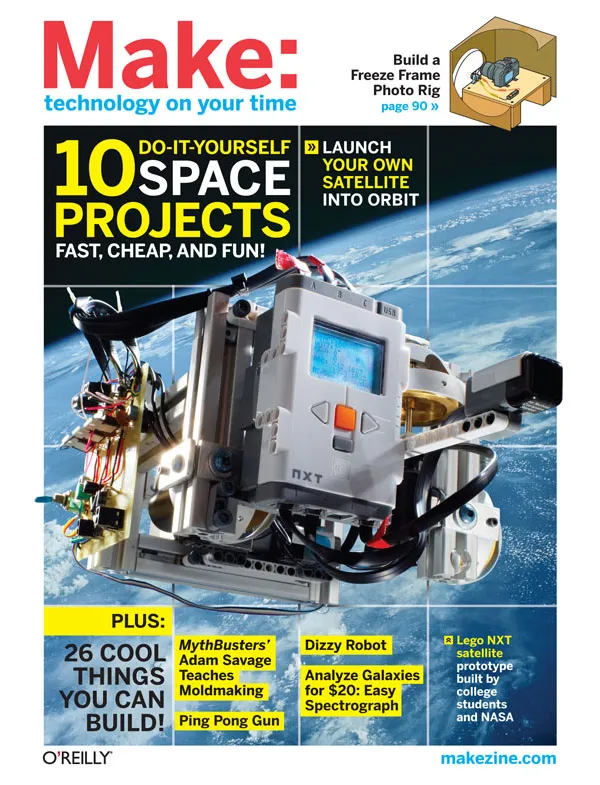
Vol. 24: Open Sourcing Space

The U.S. space program that I grew up with is gone. Yet our fascination with space is not.


+ Downloads & Extras:

+

Open Sourcing Space

By Dale Dougherty

With one exception, Silicon Valley lacks monumental landmarks that signify its importance as a world capital of technology innovation. That exception is Hangar One at Moffett Field in Mountain View, Calif., which is the home of NASA Ames Research Center.

Hangar One stands out like a Great Pyramid visible from Highway 101. Built to house airships called dirigibles or zeppelins, Hangar One opened in 1933. The floor inside this freestanding structure covers eight acres, and its enormous clamshell doors were designed for the passage of these airships. The hangar reputedly creates its own climate inside, bringing rain unexpectedly to parties that were organized there, back before it was closed.

Today, the future of this historic structure depends on NASA and various groups debating whether to restore it or tear it down. (Its walls are covered with siding that contains asbestos and PCBs.) Those who would preserve it recognize its power as a cultural symbol. While the days of airships are mostly gone — Airship Ventures now runs zeppelin tours from Moffett Field — Hangar One remains an inspiration.

Inspiration was a by-product of the space race in the United States. Many, like me, thought of themselves as part of the space program, following the Mercury and Apollo missions, even if our role was limited to watching TV. The goal of a moon landing inspired young men and women to become scientists and engineers. They entered NASA with great enthusiasm to become part of something as big as they could imagine.

Many had satisfactory careers inside NASA, while others grew frustrated as NASA became a slow-moving bureaucracy. Increasingly, NASA made it harder (and more costly) to do anything. So, like the age of dirigibles, the U.S. space program that I grew up with is gone, and like Hangar One, its future is uncertain. Yet our fascination with space is not.

One cause for hope is that the future of space exploration doesn’t depend solely on NASA. Bruce Pittman, who works in the Space Portal group at NASA Ames, calls this future “Space 2.0.” If Space 1.0 was a “one-size-fits-all” approach with NASA controlling everything, Pittman says, then Space 2.0 depends upon “massive participation,” harnessing enthusiasm and expertise in places around the globe.

Space 2.0 represents the open sourcing of space exploration, a new model that could lead to faster, cheaper ways to develop space technologies.

It’s also a call for makers to participate in research and development. Just as we’re seeing amateurs play a role in astronomy and other fields, amateurs will be undertaking projects in support of a next-generation space program. For example, Lynn Harper of NASA Ames points out that the commercialization of space will mean a huge increase in suborbital flights, and a growing field of research in microgravity. She says this research requires “not just hundreds of experiments to send into space, but hundreds of thousands.”

In this “DIY Space” issue of MAKE, you’ll meet all kinds of makers, some inside NASA but many more outside the agency. We look at how to build your own homebrew satellites that take payloads into near-space and even into orbit. We show you how to build fast, cheap gadgets to analyze galactic spectra or eavesdrop on the space station. We also look at a variety of space-related projects seeking the participation of makers like you, from smartphone satellites to lunar mining robots.

For his report “Rocket Men,” Charles Platt interviewed the makers of a new private space industry. He also visited the Mojave Air and Space Port, where individuals and small companies set up to do space research. Spaceport manager Stuart Witt says, “I offer people the freedom to experiment.” That’s all you really need. The future, if you’re so inspired, is up to you.

Join the conversation -- every MAKE article has an online page that includes a place for discussion. We've made these RSS and Atom feeds to help you watch the discussions: subscribe.

Downloads & Extras

All the stuff you need to build the projects in MAKE, and exclusive online features direct from the staff of MAKE.

Volume 30»  Volume 29»  Volume 28»  

Connect with Make


Other Issues


Make: Volume 30 Cover Image Make: Volume 29 Cover Image Make: Volume 28 Cover Image Make: Volume 27 Cover Image Make: Volume 26 Cover Image Make: Volume 25 Cover Image Make: Volume 24 Cover Image Make: Volume 23 Cover Image


Current Discussions

Join the conversation - many MAKE articles have an online page that includes a place for discussion.

The Brain Machine -- Confused about leds
Hi Mitch, Certainly will give it a try and will post details when I've got something presentabl...

Mint-Tin Amp -- what is the use of R2
My electronic knowdges is poor,please tell me!...

The Brain Machine -- Confused about leds
Hi peckerdunne, Sounds like a cool project for making interesting visual effects. If you want to...

The Brain Machine -- Confused about leds
I'm just about finishing something similar. I'm using a msqeq7 (graphic equaliser) chip to ...

Sound Sucker -- From my dad..
(Posted for my father - who was having problems sending) The tone pressure wave travels down the ...

Make:Projects
A How-to Projects Community for Makers

Arduino
All You Need to Get Started with Arduino & More!
