








Make: Projects

Laser Projection Microscope

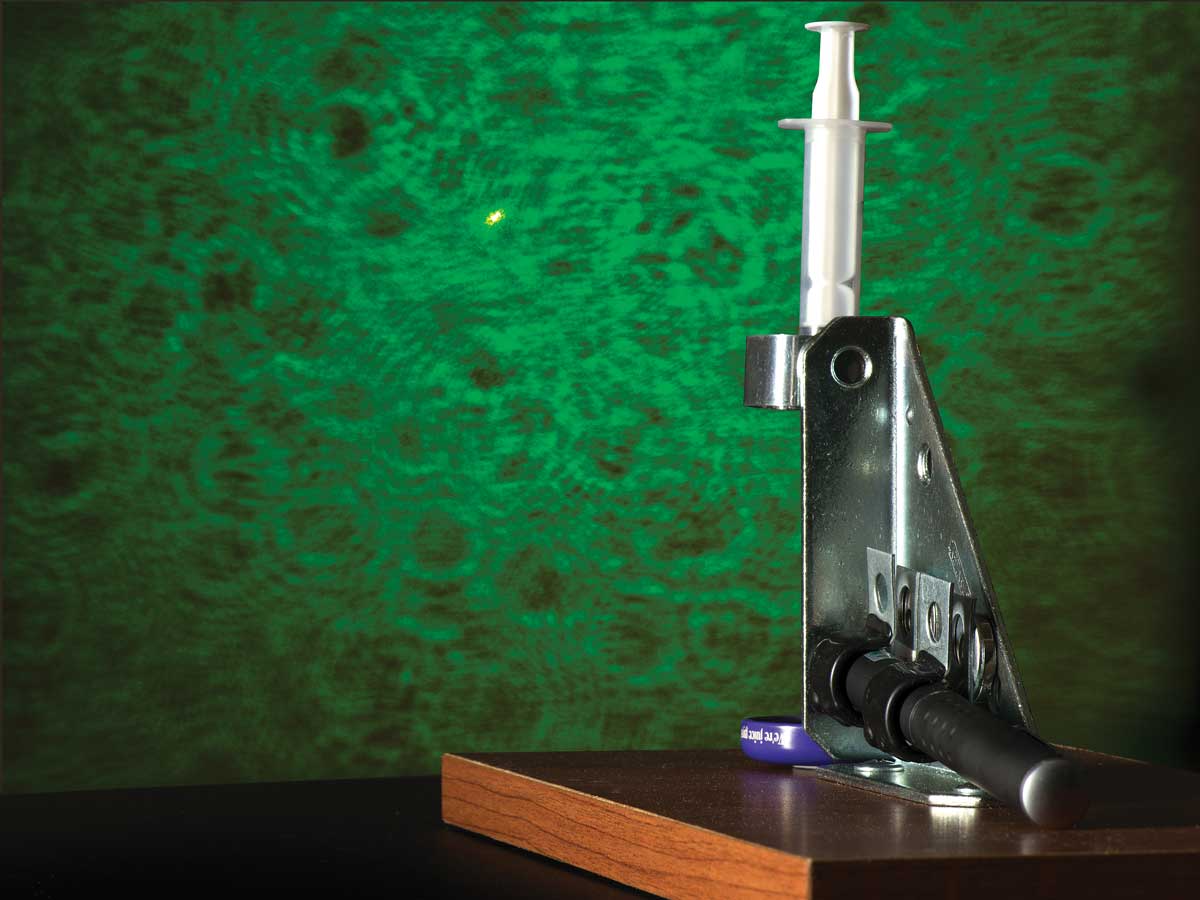
Laser pointer + drop of water = microbial movie theater!

  • By Sean Michael Ragan
  • Category: Science
  • Time Required: 1 hour
  • Difficulty: Easy
Laser Projection Microscope

Update: The earliest publication of this idea I am now aware of is:

“Water-drop projector”

Gorazd Planinsic, Phys. Teach. 39, 76 (2001), DOI:10.1119/1.1355162

This paper can be freely downloaded here. A formula for calculating the approximate magnifying power of the projector based on the radius of the droplet, the refractive index of the liquid, and the distance to the screen is given on p. 20.

Inspired by this page over at Teravolt.org, this project is near the top of the list when it comes to getting the most bang for your buck. Whether you’re a scientist yourself, a science educator, or just, you know, a bright curious monkey, this is one of those you really have to try for yourself.

The tricky part is getting everything aligned just right–the laser, the projection surface, the hanging drop of water–but this simple stand from junk-box odds and ends makes it much, much easier. The laser and syringe are mounted to broom clips on supermagnet bases which allow for easy positional adjustments, but hold strongly enough to keep everything positioned once you’ve got it tuned right. You can even pick the whole thing up and move it to another surface without perturbing the alignment.

Steps

Step #1: Mount corner brace

Next
Laser Projection MicroscopeLaser Projection MicroscopeLaser Projection Microscope
  • Use scissors to cut a strip of mounting tape to fit one side of the corner brace.
  • Adhere it to one side of the corner brace.
  • Remove the protective film from the other side of the tape, and affix it to the base.

Step #2: Assemble mounting clips

Next
Laser Projection MicroscopeLaser Projection MicroscopeLaser Projection MicroscopeLaser Projection Microscope
  • Each clip consists of a 10/24 machine screw, a countersunk ring supermagnet, a broom clip, a hex nut, and a stack of three or more #8 flat washers to provide height adjustment.
  • Depending on your particular laser, corner brace, and syringe, you may have to experiment with the length of the screws and the number of washers in each clip.
  • Here's what worked for me:
  • Each of the two syringe clips uses a 3/8" machine screw and a stack of 3 #8 washers.
  • The front laser clip uses a 1/2" machine screw and a stack of 6 #8 washers.The rear laser clip uses a 1/2" machine screw and a stack of 4 #8 washers.
  • Insert the screw through the countersunk ring magnet, add the washers one at a time, then the broom clip, and finally a hex nut.
  • Tighten by gripping the nut with a pair of needle-nose pliers while turning the screw with a screwdriver. Don't overtighten.

Step #3: Load syringe

Next
Laser Projection MicroscopeLaser Projection MicroscopeLaser Projection MicroscopeLaser Projection Microscope
  • Exercise extreme care when handling a syringe. Use a blunt needle with a cap, and leave the cap in place at all times when the syringe is not in use. If you don't have a cap, bury the tip of the needle in a wine cork when it is not in use.
  • Do not underestimate the potential dangers of stagnant and/or septic water. Use gloves when handling it, and wash your hands carefully when you're done.
  • I started out with scummy water from a drainage ditch, but eventually discovered that water with dirt from a flowerpot that had been standing in a windowsill overnight was just as interesting.
  • Load the syringe with about 1mL of your sample by inserting the needle into the liquid and pulling back on the plunger.

Step #4: Assemble

Next
Laser Projection MicroscopeLaser Projection MicroscopeLaser Projection Microscope
  • Attach the magnetic clips to the corner brace. The two laser clips go on the horizontal arm, with the taller clip in front. The syringe clips go on the vertical arm. Try not to let the supermagnets "snap" against the metal too hard.
  • Mount the laser in the clips on the horizontal arm of the brace. Make sure the lens is aligned with one of the holes in the corner brace upright.
  • Mount the loaded syringe in the clips on the vertical arm of the base, with the plunger up. Align the tip of the needle just above the lens of the laser.
  • Set the bottle cap underneath the syringe to catch any drips.

Step #5: Fire it up!

Laser Projection MicroscopeLaser Projection MicroscopeLaser Projection MicroscopeLaser Projection Microscope
  • CAUTION: To be effective, this project requires a Class 3B laser in the 5-500mW output power range. These lasers present real hazards to vision, and should not be used without appropriate protective eyewear. Even with eye protection, never look directly into the beam of a laser, and beware of the danger of reflection from shiny surfaces, such as the metal parts used in the projector itself.
  • Put on wavelength- and power-appropriate protective eyewear for your laser.
  • Position the projector on a flat, level surface, above waist height, about 15-20 feet from the projection surface.
  • Activate the laser, and adjust the position of the stand and/or laser mounting clips to center the laser dot on the projection surface.
  • Depress the syringe plunger lightly to extrude a droplet of liquid at the tip of the needle.
  • Being careful to avoid looking directly into the beam, adjust the position of the syringe until the water droplet is perfectly centered in the beam path. This will be obvious from the projected image. When you've got it, the bright dot will mostly disappear and the microscopic image will appear.
  • If your image has a lot of noise that rotates with the laser housing, that probably indicates dust on the lens. Cleaning mine with a cotton swab moistened with rubbing alcohol did wonders for the image quality.

Conclusion

Update: The earliest publication of this idea I am now aware of is:

"Water-drop projector"

Gorazd Planinsic, Phys. Teach. 39, 76 (2001), DOI:10.1119/1.1355162

This paper can be freely downloaded here. A formula for calculating the approximate magnifying power of the projector based on the radius of the droplet, the refractive index of the liquid, and the distance to the screen is given on p. 20.

An improvement on this design might incorporate a "heavy duty corner brace" having a triangular third side, such as the Stanley #755565, with the laser attached to the vertical, triangular side instead of to the horizontal base, to allow greater adjustability in the up/down projection angle.

Also, it has been suggested that it may be possible to focus blue and red lasers on the same drop, simultaneously, and achieve a 3D projection when viewed through red/blue 3D glasses. My experience with this monochrome projector suggests that getting everything aligned correctly for such a system would be challenging, but certainly not impossible.

Finally, I am curious as to the effect that changing the laser color may or may not have on the quality of the image. As soon as I get my hands on red and/or blue lasers in an appropriate power range, I will try that experiment and post my results.

Leave a Reply

Fill in your details below or click an icon to log in:

WordPress.com Logo

You are commenting using your WordPress.com account. Log Out / Change )

Twitter picture

You are commenting using your Twitter account. Log Out / Change )

Facebook photo

You are commenting using your Facebook account. Log Out / Change )

Connecting to %s

%d bloggers like this: