Penny-Powered LED
Read this article in MAKE:
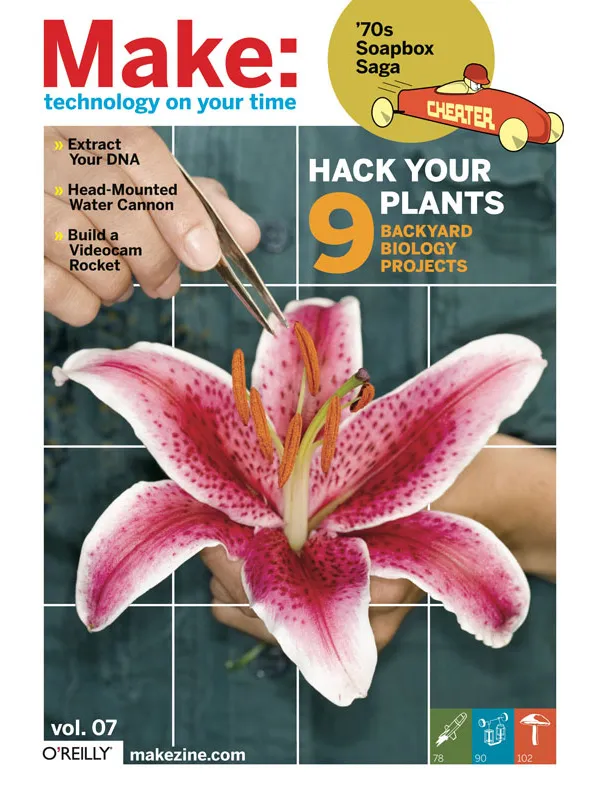
07: Backyard Biology, Page 17.
To get MAKE, subscribe or purchase single volumes.
Power an LED with some salty water and $1.21.
From the column 123
Errata for this article
Correction for page 17
In the Penny-Powered LED article on page 17, we implied there was zinc on the outside of the dimes, when in fact there isn't any zinc on the exterior surface of any U.S. coins -- it's all nickel. Zinc is too soft and reactive, but there is
still enough potential between the nickel and the copper to make a battery. However, it would work better with zinc.
MAKE: Noise — Discuss this article
You must be logged in to post a talkback.[ Display main threads only] [ Oldest First]
Showing messages 1 through 9 of 9.
- Thanks for the electrical tape tip!
Reply
With electrical tape stretched across the top of each rib, we were able to hold the paperclip pieces down, even with a icecube tray that wanted to pop them up. We used non-shiny pennies, pre-1990. We produced 1.5 volts, which wasn't enough to get a very bright light, but it was enough to get my three sons (ages: 5,6,10)to sing an impromtu victory song. We'll be moving on to lemon batteries next!Posted by anjalij on January 02, 2008 at 19:26:57 Pacific Time
- We did it!
Reply
Posted by anjalij on January 02, 2008 at 19:16:02 Pacific Time
- This Experiment Does Work when done with care.
Reply
Conventional Ice Trays are difficult but there is a work around. Use Black Electricians tape to hold the paperclips or rather half of the paperclip onto the top ridge of the icecube tray. Cut the paperclips in half and use the U shaped pieces to hold the pennies and dimes, make sure the the paperclip only holds the upper half of the coins. Now mix up the water and table salt and pour it into each separate cell very carefully and only allow enough liquid to fill the cell up until it just covers the lower third to half of the coin making sure that none of the liquid is touching any part of the paperclip. Then slide the short end of the LED in the side that ends with a dime and put the long end in the side that starts ends with a penny and it should light up. I read 2 volts during my experiment. Just be careful during construction and it should all work out fine. Also I used an LED that was rated for 1.7 volts 25 mA DC and also one that was rated for 2.1 volts 25 mA DC, both worked fine.Posted by uh1hhuey on October 06, 2007 at 23:04:28 Pacific Time
- Can you imagine the throwie with this thing?!
Reply
Totally awesome!Posted by MagicSafire on January 18, 2007 at 17:54:11 Pacific Time
- Turning this project into lemonade...
Reply
As an avid MAKE reader (since the first issue), I was disappointed with this project. I attempted to make the battery with my daughter, for a science fair project, but got the same poor results as others have reported.
Here's what ended up working great for us: we stuck a piece of thick copper wire in one end of a lemon, and a "galvanized" screw in the other. (Galvanized screws and nails have a zinc coating.) This combination produced almost 1 volt. Three together lit the LED fine.
Posted by blistick on November 07, 2006 at 17:25:02 Pacific Time
Reply
Note: I havn't built the device, I'm just looking at the diagram.
Surely this would work better if there was a nickel and a dime connected to the LED wires? So that the last two cells actually work as cells, with the right electrodes in them. As shown, the LED wires (tinned) go into the electrolyte, but they're the wrong metals to make a working cell.
Also, if this setup can only generate 110uA, you'll need a very efficient LED to have it light up. That's about one-tenth of a milliamp, and LEDs need more like 10mA to light up properly.
Posted by c0redump on November 07, 2006 at 07:23:27 Pacific Time
- I call BS on this project
Reply
As mentioned by others, it just doesn't work as advertised. The sloping sides, the clean pennies, the 10 * .5 = 2 issue. PLUS, you have to be really careful (apparently) not to fill the cubes too full because then the water contacts the paperclip and you get a short (?).
Maybe I'll try foil. Or maybe I just do it the old fashioned way: A stack of pennies, dimes and electrolite-dampened paper towels.Posted by drysdam on September 25, 2006 at 19:08:04 Pacific Time
- Same problem
Reply
I tried both pennies and foil to see if I could get it up and glowing, and only the foil worked. Also, it would only work with the short end in the dime bath and the long end in the "penny" bath. Pretty cool tho :)Posted by cwillis on August 22, 2006 at 13:53:24 Pacific Time
- Issues with project
Reply
I attempted to put together the Penny-Powered LED but ran into some problems:
1. Conventional ice cube trays have sloping sides so that the ice cubes come out easily. These make it difficult to keep paper clips on. I am curious what sort of tray has the straight sides shown in the article and how the ice cubes are removed from it.
2. This doesn't work unless the pennies are clean. This was a significant ommission. Also aluminum foil works better than pennies and is easier to install as well as already being clean and shiny.
3. I don't understand why the article says that each cell produces about 0.5V (which is what I measured), but 10 cells in series produce 2V. Maybe it is referring to the diode drop of the LED?Posted by mitchb on August 19, 2006 at 18:47:58 Pacific Time
|
Showing messages 1 through 9 of 9. |
Join the conversation -- every MAKE article has an online page that includes a place for discussion. We've made these RSS and Atom feeds to help you watch the discussions: subscribe.

Why advertise on MAKE?
Read what folks are saying about us!
Click here to advertise on MAKE!
Explore More in Make Magazine
Search the pages of MAKE
Raves for MAKE!
“Now we've got geek DIY (do it yourself) porn. Just as would-be Emerils pore over lushly illustrated cookbooks with recipes involving hard-to-find morels and complicated instructions for roux, Tom Swift wanna-bes are devouring MAKE.”
— Steven Levy, Newsweek
“...O'Reilly Media recently launched what has already become the bible of this new movement, a magazine called MAKE.”
— Daniel Roth, FORTUNE
“If you're the type who views the warnings not to pry open your computer as more a challenge than admonition, MAKE is for you.”
— Rolling Stone
“One of the most innovative magazines I've seen in a long time.”
— Steve Riggio, CEO Barnes & Noble
“The kind of magazine that would impress MacGyver”
— Marcus Chan, San Francisco Chronicle
|
|