Patently Curious
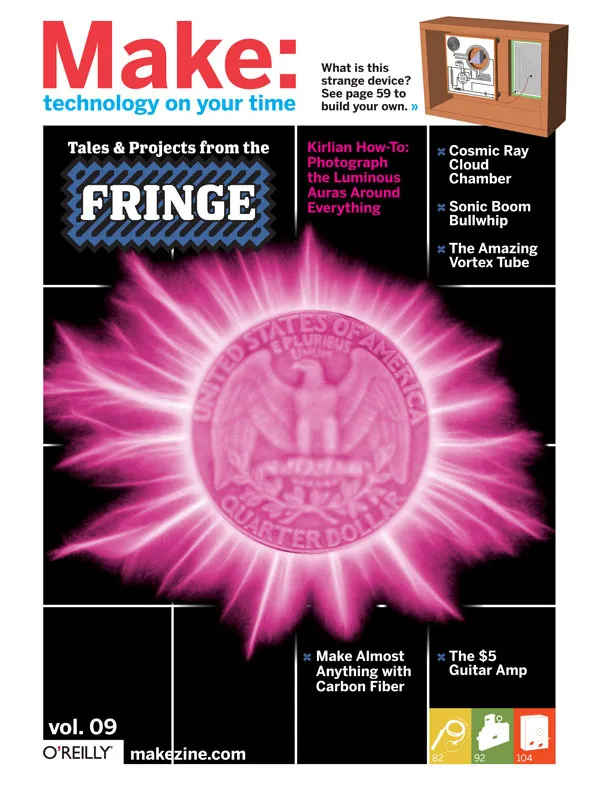
Read this article in MAKE:
09: Fringe, Page 50.
To get MAKE, subscribe or purchase single volumes.
Physicist Tom Valone looks at technologies most scientists consider junk.
Links
- PhACT on magnetic machinery
- Oceans of Free Energy
- Howard R. Johnson on magnetic motors
- Wikipedia: Thomas Townsend Brown
- Official Townsend Brown website
- Wikipedia: Air Car
- Engineair
- The Air Car
- LEDs and Bioelectromagnetics
- Exploiting Zero-Point Energy
- Wikipedia: Steorn, Ltd.
- Wikipedia: SMOT
- The Basement Mechanic's Guide to Building Perpetual Motion Machines
- Tom Valone's Integrity Research Institute
- JLN Labs
Make: Noise — Discuss this article
You must be logged in to post a talkback.[ Display main threads only] [ Oldest First]
Showing messages 1 through 2 of 2.
- The term is Pseudoscience, not Fringe Science
You must be logged in to reply.
I realize the author was attempting to be even-handed in his approach to the subject matter, but the tone of the article was definitely in line with the way pseudoscience apologists always frame their case:
"Valone found himself the target of a jihad waged by guardians of establishment science"
This is typical of the way proponents of pseudoscience portray themselves; under attack from evil forces that want to destroy their discoveries. In actuality, all a free-energy inventor would have to do is create a working model that can be independently verified, and they'd have more money thrown at them than they would know what to do with. Despite decades of private investors pumping millions of dollars into these scams (do a Google search for "Carl Tilley"), not a single verifiable working model of any of these devices has ever been produced. Just because something is patented doesn't mean it works.
Other statements are not questioned by the author:
"Where are we going to get energy from in the future?" he asks. "None of conventional science can answer that question."
Excuse me, conventional science has developed ways to harness the power of sunlight, wind, wave motion, biomass and geothermal energy. How many btus of energy have free-energy devices produced in all of history? 0.
I object to the term "fringe science" as it is applied here because it implies that it refers to a true science that is not yet mainstream. Human cloning is a fringe science. It's plausible, certainly possible, but whether it's actually been done hasn't yet been verified.
The devices discussed in this article are pseudoscientific in nature: They use the terminology and trappings of science to try to lend credibility to things that have been disproven or are not possible given what we know of the laws of physics. Any physicist who believes that he's going to discover a new fundamental law of physics in a shed in his backyard, while it eludes teams of researchers working in controlled, multi-billion dollar supercolliders and research labs, is as delusional as the people who claim to have built perpetual motion machines.
Inventing involves applying the laws of physics in new ways, not rewriting the laws of physics to suit your beliefs.
Publishing an article about a Physicist who believes this stuff serves to lend credibility to something that doesn't deserve it.
How about a follow-up article about the history of free-energy scams?
Posted by Moon_Rabbit on February 16, 2007 at 22:18:47 Pacific Time
- The term is Pseudoscience, not Fringe Science
You must be logged in to reply.
While it's true that many pseudoscientists make bogus claims of persecution and suppression, in Valone's case clearly it occurred. What else do you call it when you're kicked out of your job and the guy who engineered this brags about it at a meeting of American Physical Society?
Similarly, Tesla really was harassed by law enforcement, and Nader (a "crackpot" in his day) really was follows by PIs hired by GM.
As for the semantic issues, you could argue (well, you did argue) that I was a little more sympathetic than the facts justify, but this is an area where I am not going to please everyone or, perhaps, anyone.
Re "fringe science," some of the items I mentioned certainly are correctly described thus; for instance a car running on compressed air violates no physical laws. My definition of "fringe science" would be "phenomena which we cannot fully evaluate yet." Zero Point Energy certainly seems to fall into that category.
Thanks for your comments.
--Charles PlattPosted by charlesplatt on February 17, 2007 at 05:09:06 Pacific Time
|
Showing messages 1 through 2 of 2. |
Join the conversation -- every MAKE article has an online page that includes a place for discussion. We've made these RSS and Atom feeds to help you watch the discussions: subscribe.
Explore More in Make Magazine
Search the pages of MAKE
Raves for MAKE!
“Now we've got geek DIY (do it yourself) porn. Just as would-be Emerils pore over lushly illustrated cookbooks with recipes involving hard-to-find morels and complicated instructions for roux, Tom Swift wanna-bes are devouring MAKE.”
— Steven Levy, Newsweek
“...O'Reilly Media recently launched what has already become the bible of this new movement, a magazine called MAKE.”
— Daniel Roth, FORTUNE
“If you're the type who views the warnings not to pry open your computer as more a challenge than admonition, MAKE is for you.”
— Rolling Stone
“One of the most innovative magazines I've seen in a long time.”
— Steve Riggio, CEO Barnes & Noble
“The kind of magazine that would impress MacGyver”
— Marcus Chan, San Francisco Chronicle