





MAKE 19: Robots
Buy a copy of Volume 19.
Take a tour of Volume 19 with the editors of MAKE.
Michelle Stitzlein builds 11-foot-wide moth sculptures. Page 18
Mike Sheldrake makes cardboard wave vehicles. Page 20
Clayton Bailey has made about 100 life-sized robot sculptures, all carefully constructed from found objects whose previous incarnations contribute something unique. Page 21
Benjamin Van Oosts Favela sculpture is made entirely of trash recycled boxes, pieces of metal found on the street, toilet paper rolls, and aluminum cans. Page 22
Mike Sandlin has created a lightweight set of gliders that are intended to provide open air soaring, forgiving flight characteristics, convenient transport, simple garage technology construction, and a high level of crash safety. Page 23
Austin-based artist Magda Sayeg and her group of urban knitters, Knitta Please, have gone on several covert midnight missions to knit cozies for anything from car antennas to street sign poles and trees. Page 24
With help from artist Marisa Jahn and Steve Shada, MIT Media Lab research assistant Cati Vaucelle created the WoW Pod, a cocoon that structures a relationship between your physical body and your avatar, she says. Page 25
Give an old standby some new flavor and create a perfect rainy-day activity when you make your own memory game out of materials you already own. Page 29
Power an LED with lemons or spare change. Page 110
Instant speakers from earbuds. Page 139
Ugo Conti's Proteus boat behaves like a water skipper. Page 30
Takayuki Ohira creates planetariums for everyone. Page 36
An interactive concrete interface. Page 38
What Cape Canaveral is to astronauts, the Bonneville Salt Flats are to those who love to drive fast. Page 40
A new TV series puts the inventions of perhaps the greatest of all makers to the test. Page 43
The Network Relief Kit brings online connectivity to disaster sites. Page 44
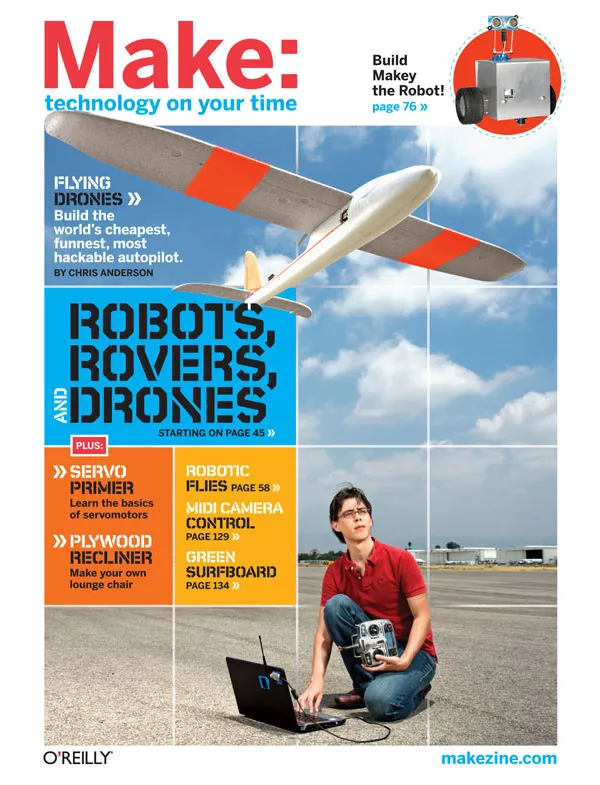
Real robots think for themselves. Page 1
DTV antennae, fine print, energy ideas, and love for Roy Doty. Page 12
Sell MAKE subscriptions and your club keeps 50 percent of the proceeds. Page 15
Fight against the greed of a small band of vocal dinosaurs. Page 17
Tree rings can tell us about past precipitation, climate, major volcano eruptions, and forest fires. Page 26
Mr. Roboto: Cut and fold your own paper bot! Page 45
Build the worlds cheapest, easiest to hack, and funnest autopilot. Page 46
Introducing a new kit to build the fastest, most nimble blimp around. Page 52
Reconnoitering the UAV exhibition at the National Air and Space Museum. Page 53
Robot engineers and enthusiasts discuss whats currently holding their attention. Page 54
The director of the Harvard Microrobotics Lab builds a better housefly. Page 58
Make a vintage robot smarter. Page 62
How a neurophysiologists experiments in brain behavior created the first autonomous robots. Page 68
Rovers at the first annual SparkFun Autonomous Vehicle Competition have minds of their own. Page 72
Build this simple autonomous robot thats programmed to follow objects around. Page 76
This recliner is very comfortable, easy and inexpensive to build, and can be assembled or disassembled in a few minutes. Page 88
Make a lightweight night-cycling vest that displays your current speed in glowing, 7-inch-tall numbers easily visible to cars. Page 100
Turn a classic toy into a hot rod for kids of all ages. Page 111
The Alarm Purse is a simple, fashionable way to add an audible alarm to your handbag. Page 114
Solar-cell links are cleverly boosted to drive an LED jewel. Page 117
Guitar effects from old compact fluorescent light bulbs. Page 120
Open and repair a damaged proximity swipe card. Page 121
Candy tin device helps keep your air clean and your lungs healthy. Page 123
Got commercial organizers that fail to fit? Make your own. Page 126
Give your metalwork a gleaming texture that makes light dance. Page 128
ESPN-style coverage with a video crew of one or two. Page 129
Look more trustworthy while video-conferencing. Page 133
Surfboard kit uses a new epoxy technique without fiberglass. Page 134
Beef up on robotic musculature. Page 140
Extend your grasp. Page 149
Pamphleteer William Cobbett launched the sustainability movement - in 1821. Page 150
The creator of MacGyver challenges you to make your way back to shore after falling asleep in a kayak and awaking to rough seas. Page 152
This speargun gets its power from a strip of red rubber. Page 154
Trouble at the Robot Invitational. Page 155
Titanium nail puller, autonomous blimp kit, Mad Science, and extra heavy duty screwdrivers. Page 156
Make a five-pointed star with a single cut. Page 164
Build a fire piston. Page 166
Page 169
Correct myopia with pinholes. Page 175
Page 176