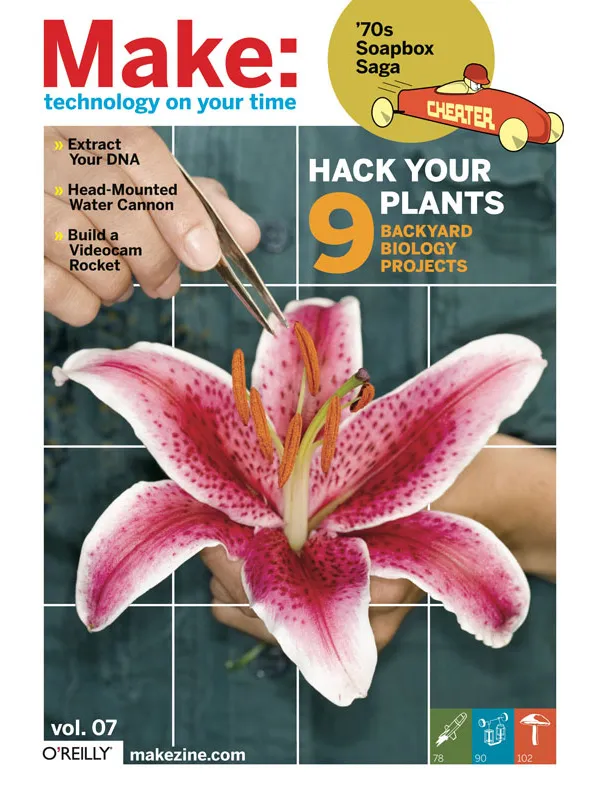
Hack Your Plants!

Play God in your garden--create custom fruits, flowers, veggies, and more.

By Robert Luhn

Tools of the trade: Tweezers, small clean paintbrush, magnifying glass, glassine bag

Rules of the road: Being the first on your block with a DaffoMelon would be cool, but don't hold your breath. Typically, you can cross plants of the same species to create a new variety. You can also make successful crosses between different species in the same genus, such as the raspberry (Rubus idaeus) and blackberry (Rubus Rosaceae), which results in a loganberry. Rare, however, is a cross between plants from two different genera. Adjust your expectations accordingly.

As you might expect, crossbreeding is easiest with plants that boast big sex organs -- clearly defined and separated stamens and pistils. Two obvious candidates would be daffodils and tulips, but get the MO on a plant's life cycle before you cross it with anything. You might have to wait several years before a flower appears. (Our reference of choice: Charles Welch's Breeding New Plants and Flowers.)

Hack the plant: To get the 411 on the mating dance, we spent the day with Todd Perkins, a flower breeder at Goldsmith Seeds. His recommendation? First, work with a plant that normally has prominent organs (such as the petunia), so you can easily control the pollination. (If you don't, you'll definitely need that magnifying glass.) If you have the time, grow several varieties of the plant and let them cross naturally. Select the offspring you like, and grow their seeds. Repeat this process until you have two plants with the traits you want to meld.

Using tweezers, emasculate (ouch) the target flower by removing its stamen. (The stamen often look like tiny stalks that ring the center of the flower; the pollen-bearing tip is called the anther.) This will prevent the plant from pollinating itself. From the source flower, collect pollen from the tip of the stamen with a small paintbrush. Trot over to the target flower, locate its stigma (it's often a tall tube in the center of the flower, which leads to the plant's ovaries) and brush the pollen on it. Tag the flower that's been pollinated, noting date and which plant/flower was the pollen source. Finally, slap a chastity belt -- a glassine bag -- over the flower to prevent pollination from other sources.

In less than 24 hours, fertilization will occur and the flower will wilt. (Why? First, to prevent further pollination, and second, to force the plant to marshal its resources for reproduction.) In as little as four weeks, you'll get seeds. Plant the seeds and you'll get your hybrid plant, right?

Not exactly. Thanks to the nature of sexual reproduction and recombination, you'll get plants exhibiting a huge mix of characteristics from their grandparents.

One solution? From this first batch of plants, pick the ones that are closest to your ideal, and mate them with the best parent. (A practice known as back crossing.) This will produce seedlings that contain 75 percent of the parent's genes. Pick the plants from this next batch and pollinate each plant with its own pollen. This should effectively lock in the characteristics you want. The seeds from these plants should be nearly identical and generate the hybrid you want.

The big exception? This only works if you're selecting for simply inherited traits -- those tied to a single gene. With traits controlled by multiple genes, the plants you grow from seed will still be all over the map.

The second solution? Once you've got a plant that's close to your ideal, clone it. Take cuttings from the plant, place them in the appropriate medium (such as peat and perlite), add water and perhaps, a rooting hormone, and soon shoots and roots will develop. Plant 'em and voila -- up comes your hybrid. "This is the lockbox," says Goldsmith's Perkins. "It's the one sure way to preserve the hybrid that you've created." (For more on cuttings, see ag.arizona.edu/pubs/garden/mg/propagation/asexual.html).

Tips, tricks, and traps:

  • Just starting out? Limit yourself to one or two projects. Good starter veggies and fruit include tomatoes, squash, and melons. Good starter flowers include geraniums, fuchsias, and petunias
  • Get Mendelian. "This isn't for the casual gardener," says Andy Mariani, of Andy's Orchard in Morgan Hill, Calif. "To juggle the recessive and dominant traits, you must have an elementary understanding of genetics." Start with the books in the Resources sidebar
  • Pick the right parents. Closely examine the two plants you want to cross. Are they robust, superior specimens, from buds to color to flowering? Only pick the best of the best
  • Nip it in the bud. To stop self-pollination at all costs, gently open the flower while it's still a bud and remove the stamens. Then cover it for a day or two, until the stigma is ready to take the pollen
  • When it comes to sex, timing is everything. The pollen from the source flower must be fresh and the stigma in the receiving flower must be ready. How can you tell? This varies by species, but in some flowers, the stigma grows tall and splits -- a sure sign it’s ready for pollen. In others, the stigma becomes sticky and glistens (the mucus captures any pollen blowin' in the wind or dropped by a passing bee). If the stigma is dry, the moment is gone.

Pollen has a limited shelf life -- 24 to 48 hours, tops. So check the donating flower as soon as it opens. With many plants, fresh pollen is soft, loose, and fluffy, and comes off the anther easily. Note: some pollen is designed to be sticky, so bees will carry it off.


Links

Errata for this article

Correction for page 74
In the Tips, Tricks, and Traps section on page 74 in Volume 07 the fifth bulleted item should express degrees in Fahrenheit, not Celsius.

The sentence should read: "Keep your scions cool. "Dormant scion wood -- stems from pear, apple, peach, cherry, and other trees -- is best stored between 30 and 38 degrees [Fahrenheit]," notes Real.

Join the conversation -- every MAKE article has an online page that includes a place for discussion. We've made these RSS and Atom feeds to help you watch the discussions: subscribe.

Advertise here with FM.

Why advertise on MAKE?
Read what folks are saying about us!

Click here to advertise on MAKE!

Subscribe to MAKE Magazine!
Important please read

Search the pages of MAKE

Raves for MAKE!

“Now we've got geek DIY (do it yourself) porn. Just as would-be Emerils pore over lushly illustrated cookbooks with recipes involving hard-to-find morels and complicated instructions for roux, Tom Swift wanna-bes are devouring MAKE.”
— Steven Levy, Newsweek

“...O'Reilly Media recently launched what has already become the bible of this new movement, a magazine called MAKE.”
— Daniel Roth, FORTUNE

“If you're the type who views the warnings not to pry open your computer as more a challenge than admonition, MAKE is for you.”
— Rolling Stone

“One of the most innovative magazines I've seen in a long time.”
— Steve Riggio, CEO Barnes & Noble

“The kind of magazine that would impress MacGyver”
— Marcus Chan, San Francisco Chronicle

More Raves for MAKE

Subscribe


Advertise here.
Why advertise on MAKE?
Read what folks are saying about us!

Click here to advertise on MAKE!
Subscribe to MAKE Magazine!