



Vol. 15: Compressed Air Rocket
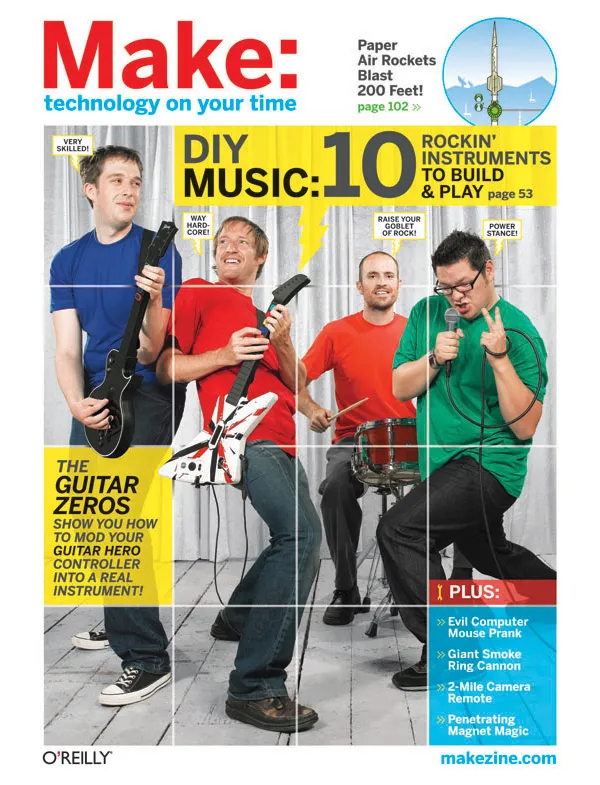
Blow your friends away as you send this 25-cent rocket hundreds of feet in the air. You can build this easy launcher and rocket with common hardware store items in an afternoon.
Photos by Rick Schertle, Gabriela Hasbun
Digital Edition
SUBSCRIBERS:Read this article now in your digital edition!
Get Make:
Subscribe to MAKE and get the best rate!
+ Downloads & Extras:
+ Building a Compressed Air Rocket Video
+ Video of the Air Rocket in Action!
» MAKE: NOISE — Discuss this article
You must be logged in to post a talkback.[ Display main threads only] [ Oldest First]
Showing messages 1 through 58 of 58.
- Too much fun update.
You must be logged in to reply.
I took the new launcher to our Cub Scout den meeting and it quickly turned in to an opportunity to get most of the kids an engineering requirement for one of the badges everyone is working on. The kids all sat around throwing out ideas to improve performance and or durability. I was really surprised by some of the things they came up with. So, I agreed to build their 10 favorite mods in time to test them at the Scout picnic on the 23rd. So far the only idea I've come up with to gauge performance between rockets is to time the interval between launch and impact. I was wondering if you might have any other ideas?
Thanks in advance, Robert.
P.S. I refused to make the most popular idea no matter how many times they asked. The idea was to place a very large nail in the nose and you would be amazed at how many "practical" reasons a group of 10 year old's can come up with! I grew up in the age of "Lawn darts", they banned those things for a reason!!Posted by Mrwade01 on June 08, 2012 at 02:46:21 Pacific Time
- Too much fun update.
You must be logged in to reply.
Hey Robert,
I posted your request for measurement ideas on the blog, and we've gotten a number of responses already:
http://blog.makezine.com/2012/06/08/gauging-performance-between-compressed-air-rocket-mods
I hope some of the comments are helpful to you.
Also, I would love to see photos from the picnic, with any stats you collect! If you think of it afterwards, please send them my way: lcochrane [at] oreilly.com. it might be fun to share a follow-up to this blog post.
: )
Thanks!
LauraPosted by Laura Cochrane on June 08, 2012 at 12:10:51 Pacific Time
- Too much fun update.
You must be logged in to reply.
Thanks for the update. My son is in Cub Scouts too. Leave to ten year olds to comoe up creative (and possibly dangerous) mods. I love your commentary in the high presure "lawn dart". Good move not going forward with that one.
Cheers,
RickPosted by rschertle on June 08, 2012 at 09:40:19 Pacific Time
- Too much fun!
You must be logged in to reply.
I cant thank you enough for putting this project out here! I started out building the launcher to entertain my two boys. The sugar rush like symptoms it gave my "inner child" are just a bonus! I build ours using the tire valve and it seems to work very well. I have 2 tips on making the rockets that really make things easier for me. 1) use a spray bottle to mist the card stock lightly before forming the tube and cone but give them a minute to dry before tape. 2) After you have a finished cone that your happy with, use it to form the moist card stock over for the next one. This has really made things go faster for me. Thanks again!!Posted by Mrwade01 on June 04, 2012 at 16:46:48 Pacific Time
- Too much fun!
You must be logged in to reply.
Great to hear that you enjoyed the project so much. We've had a lot of fun with this over the years. Thanks for the build tip on the nosecone. Always helpful to get some new takes on how to build the rockets. Keep an eye out on the next issue of MAKE 31 where I've got a how to on building a folding-wing catapult glider.
Cheers,
RickPosted by rschertle on June 04, 2012 at 21:45:50 Pacific Time
- Super fun! Maybe try manual valve.
You must be logged in to reply.
We are having so much fun with this project!
The rainbird electric sprinkler valve was releasing suddenly around 30psi, so replaced it with a manual valve that opens with a 90-degree turn. Works great, and cheaper too! The path for air through electronic valve is circuitous; path through a ball valve is pretty straight!
Used the tire stem valve idea.
Building rockets same as everybody. Single layer of cardstock w/ a little overlap; spiraling packing tape. Blast cap held on by 2 layers tape. Fins out of 1/16" balsawood are easier to handle.
Air compressor with 80 psi (or maybe more) blasts rockets over 250 ft into the air. (measured using a protractor and plumb bob from 250 feet away.)
Thanks for the awesome project! We've been making rockets for a couple months now.Posted by Funk79 on March 03, 2011 at 19:02:22 Pacific Time
- Super fun! Maybe try manual valve.
You must be logged in to reply.
Great to hear folks are continuing to enjoy the rocket and launcher build. Thanks for the tips on the manual valve and mods to the original rocket design. It was nice to see you had measured the height as well. I always figured it was between 200 and 300 feet and you confirmed it!
Cheers,
Rick SchertlePosted by rschertle on March 04, 2011 at 13:37:22 Pacific Time
- Interesting
You must be logged in to reply.
I saw one of these about 20 years ago amde by a science teacher with a sprinkler valve. I decided to one up him and built one with a bigger tank and a frangible valve that opened explosively, sounded somewhat like a shotgun being fired when it went off at 100PSI. Probably not so safe, but it would go high enough to vanish and travel over a block . Legal size printer paper wrapped with 2" shipping tape for burst strength. Fins made of 3x5 cards attached with more 2" tape for less resistance. If you watched the rocket you never saw it leave, if you looked 100 feet above, you could usually catch it's flight.
The faster the valve opens, the faster the rocket leaves. Since I made mine I found there are much better valve designs out there, sprinkler valves not being one of them.
IraPosted by Extrasensory on December 08, 2009 at 15:09:11 Pacific Time
- Interesting
You must be logged in to reply.
I really like this cannon. I'm petty new to the making of it. I like the video and it's very helpful, but i would like a list of all the supplies because i can't tell the specifics of each item strictly from the video. It would really help me out if someone could post a list of all the supplies and how many of each. Thank you very much.Posted by gtflores on May 27, 2010 at 15:27:32 Pacific Time
- Interesting
You must be logged in to reply.
Hi gtflores,
The complete tools and materials list is available in the print copy of the magazine, where the full project tutorial was published (in Vol. 15). You can buy the back issue in our online store, Maker Shed.
You can also buy a PDF version of the issue.Posted by Laura Cochrane on January 10, 2011 at 16:28:45 Pacific Time
- My launcher mods
You must be logged in to reply.
http://www.flickr.com/photos/cnorrick/sets/72157609725504593/
Here are some photos from my launcher.
My mods include: Rockets made out of USPS Priority Mail Tyvek Envelopes (not yet tested), Nose cone reinforced with expanding foam.
Launcher has a more compact stance with a folding leg for compact storage, trigger disconnects with a RCA Plug, R/C car battery connects with standard Deans Plug, air hookup is a standard air tool Quick Disconnect for air compressor usage, and I made a QD to Schrader valve hose for use with bicycle air pump. I had no idea you could buy a Schrader to 1/4" MPT fitting. My local Ace Hardware had it.
Here is one on Amazon: http://www.amazon.com/gp/product/B0006B07BU/
Here is my $16 sprinkler valve from Amazon: http://www.amazon.com/gp/product/B00004S1V2Posted by TheCheatOSX on November 22, 2008 at 21:03:12 Pacific Time
- My launcher mods
You must be logged in to reply.
Great project!! Some comments:
1) I had good luck with glossy paper from magazine covers.
2) I had good luck using the 2" wide clear packing tape for reinforcement.
3) I cut fins from foam building insulation sheet stock and glue gunned them on.(cut the fin shape from 1/2" stock, then cut the thickness into 1/3rds with a 12" chef's knife)
4) At night, the kids taped chemical "glo bracelets" to the rockets and the STILL seemed to fly amazingly well.
Note: hoop stresses from pressure increase with the square of the radius so it is not surprising that pressure had to be backed way down when using 3/4" pipe. Stick with 1/2" pipe.Posted by azapplewhite on February 10, 2009 at 13:07:37 Pacific Time
- My launcher mods
You must be logged in to reply.
Well, after a few unsuccessful launches at 40 and 70 psi, I dropped it down to under 20. Success! I need to mention that I'm using 3/4" pipe for the launch tube because I had some in stock. You need to scale up the template if you use 3/4", but I wasn't really using the template anyway.
At the higher psi, it was crushing my rocket at launch. Like there was some sort of back pressure. It would only get maybe 20 feet up. With the low pressure setting, it was getting a good 200. I'm sure there is some interesting physics going on here that I need to investigate.
Posted by TheCheatOSX on November 24, 2008 at 10:22:42 Pacific Time
- Rocket Launcher: Time Lapse Build Video
You must be logged in to reply.
We built the rocket launcher last weekend, what a great build. I recorded most of it as a time lapse video, sorry, no day time rocket launches, but an LED throwie mounted to the rocket at night was a hoot! The kids loved running out in the dark to find the glowing rocket on the back lawn.
Rocket Launcher VideoPosted by shawnwaite on November 21, 2008 at 06:43:41 Pacific Time
- Rocket Launcher: Time Lapse Build Video
You must be logged in to reply.
Great video! Very well done.Posted by TheCheatOSX on November 22, 2008 at 21:04:26 Pacific Time
You must be logged in to reply.
I built on this weekend. It worked really well! Great design. The rockets seem to get pretty beat up. I was plating with the idea of making them from actual model rocket tubes with balsa fins and all that, They would be considerably heavier I imagine and may not fly as far but they would last longer.... I having trouble finding prefab tubes that will fit the 13/16 inch launch tube (.812 inches). and I am trying to think of a good material to perhaps line tubes with to make them fit. Suggestions?Posted by r05c03 on November 18, 2008 at 11:26:01 Pacific Time
- Awesome fun project
You must be logged in to reply.
Nice work. This is one of my favorite recent make projects. I took a bunch of photos and movies of our launches:
http://www.flickr.com/photos/8278630@N08/sets/72157608421577488/
and alot during assembly:
http://www.flickr.com/photos/8278630@N08/sets/72157608405904819/
I used a lawn genie 54005 valve bought off off ebay for about $15 and an old drill battery. Works like a charm and the kids love launching it and chasing it down.
Kudos for sharing a great project.Posted by swinz on November 11, 2008 at 05:34:56 Pacific Time
- Awesome fun project
You must be logged in to reply.
Loved the photos and videos! It's very rewarding to see folks enjoying the project. When I designed the setup and wrote the article, I was having so much fun I didn't think about people all over the country building it and using it!
Based on your pictures, you must live somewhere much greener than the Bay Area. Great prodution photos and it looks like your kids got a lot of exercise on the recovery as did mine. Thanks again for the feedback and pics.Posted by rschertle on November 14, 2008 at 09:31:33 Pacific Time
- Not getting rapid pressure release
You must be logged in to reply.
I have built the rocket launcher but am not getting effective release of the pressure. There are no leaks in the system but when I release the solenoid the release of pressure is slow resulting in the rocket lifting off a couple of feet and the air releasing over a period of a couple of seconds. I am using a RainBird CPF-075 with a 7 volt battery with 3000 mAmps.
Any suggestions?Posted by digsculpt on November 09, 2008 at 18:00:45 Pacific Time
- Not getting rapid pressure release
You must be logged in to reply.
I had similar problems when the rocket body was not very tight around the launch pipe. I've found that it needs to be very tight, otherwise you'll only get a 10 foot launch. For rockets that are too loose, I've been able to fix the problem by applying some masking tape onto the inside of the rocket itself, resulting in a snugger fit.
If that doesn't help, have you tried a more powerful battery?
Good luck.Posted by swinz on November 11, 2008 at 05:38:13 Pacific Time
- Great afternoon project
You must be logged in to reply.
My daughter and I built the launcher and two rockets yesterday, and fired it this morning with excellent success.
Years ago I made a potato cannon using 4" PVC for the combustion chamber (tank), and 1-1/2" for the barrel. The rocket launcher was a good way to recycle the old cannon -- I only had to buy a few new PVC pieces to make it.
The valve I found looks identical to what's in the article, but was 12V. It cost $13.
One difference to mine was I drilled a 1/4" hole in the side of the main tank, then cut the valve stem (Presta) from an innertube and glued that on the inside of the tank with RTV silicone. I used a threaded Presta valve, which has a small ring to thread on the outside and hold it tight to the tank. My bike pump attaches directly to the tank w/no intermediate hose.
This was a fun project, and we will enjoy using it. My daughter was thrilled with it today!Posted by AustinMTB on November 02, 2008 at 12:09:34 Pacific Time
- Great afternoon project
You must be logged in to reply.
That's wonderful that the project worked so well and that you and your daugher enjoyed it so much. It's always great when you can recycle old projects into new ones. That actually happened with this launcher design. I cannibalized and old 2 liter bottle rocket launcher into my prototype air rocket launcher. I've got a potato cannon on my "to MAKE" list!
I like the modification with the Presta stem. That certainly makes sense and would cut down on the costs as well. Send me a picture if you get a chance. I'm looking at writing a follow up article on other things that can be launched using this launch system such as a rocket glider. I'll keep you updated.
- RickPosted by rschertle on November 03, 2008 at 11:40:15 Pacific Time
- Pretty awesome.
You must be logged in to reply.
Although I have made the exact same design before with some slightly less peaceful intentions. Some slight design differences and you have an airgun that will shoot a ball bearing through multiple sheets of plywood. Or if your less violent, send a weighted glowstick about 300 yards. So watch out with this stuff.
What I did learn in my airgun projects was that if you remove the solenoid and fill the hole for the solenoid on the sprinkler valve with JB weld and drill a hold in the top of the valve you can attach an air hose with nozzle on it and trigger the sprinkler valve without batteries. Not as high tech but at least you don't have to waste 9volts batteries.
PS, sprinkler valves hold up to about 120psi, have fun with that, PVC will hold far more.Posted by Finchypoo on October 06, 2008 at 17:14:48 Pacific Time
- Awesome Rocket Launcher
You must be logged in to reply.
I actually did a different design! I built mine a day before this article came out. It' has been soooooo much fun.
I order to spiff mine up a bit I took an altoids tin and made a ignition switch with a safety switch too! It looks really fancy since the altoids tin is very old school looking. I've been documenting everything as well at www.mad-laboratory.com
I've been able to launch my rockets for 7 seconds
which equates to about
76 mph
and about
197 feet
in the air.
This is a great project to talk about projectile motion too. Thanks!
Posted by madlaboratory on October 02, 2008 at 16:01:05 Pacific Time
- Awesome Rocket Launcher
You must be logged in to reply.
Thanks for sharing your design. It's very cool to see different versions of the same concept. I'm interested in improvements to the rocket design I provided in the article.
I love the Altoids launch button. Are you able to trip the sprinkler valve with just the 9v battery? Thanks for the stats as well.
- RickPosted by rschertle on October 03, 2008 at 11:30:20 Pacific Time
- Awesome Rocket Launcher
You must be logged in to reply.
Yeah, you can trigger the sprinkler valve with a single 9V battery. It works just fine. The battery has to be replaced probably every other launch party, but you can get a lot of launches out of one 9V battery. I know that sprinkler valves typically require 24V, but I'm guessing that is needed to work with water since it is more dense than air.Posted by madlaboratory on October 03, 2008 at 22:27:35 Pacific Time
- Compliments on an excellent project
You must be logged in to reply.
I built the launcher last weekend and we threw a rocket party at a local park which was a great hit. As other's have mentioned, the launcher drew in others who got a chance to play with it. Fantastic project guys-- kudos to everyone involved.
The flickr photosetPosted by Dan_neff on September 28, 2008 at 21:00:04 Pacific Time
- Compliments on an excellent project
You must be logged in to reply.
Dan -
Loved the pics you sent! It's very encouraging, as the author, to see folks enjoying the project. You could take that scene and duplicate it at our local urban park in downtown San Jose; complete with ice cream vendors, homeless folks and tons of kids, right in the midst of the lauch area. Very cool!
I loved your "applicator" take on the rocket modification. Thanks again for posting the pics and sending the link.
- RickPosted by rschertle on October 03, 2008 at 11:37:52 Pacific Time
- Tire Valves and Bike Valves
You must be logged in to reply.
for my sins, I have a LARGE number of Presta-valve equipped bicycle tubes lying around my garage (http://en.wikipedia.org/wiki/Presta_valve).
The nice thing about the presta valve is that after you've hacked it off the tube with a dremel, it's a great fit for the vinyl tubing. I have a mixture of threaded and threadless prestas: I used one of the threaded ones, and the threading made it easy to screw into the tubing.Posted by davehk on September 28, 2008 at 11:35:26 Pacific Time
- Hmm... a leak I can't get rid of
You must be logged in to reply.
Hey - everything's fine EXCEPT that I have a wee hiss on the chamber/reservoir side of the screw coupling to the sprinkler valve. I can't actually tighten it any more. Have teflon tape in the threads.
I can still pump it up to 70 PST and it'll hold that for about 30 seconds and then gradually start draining.
Any advice on how I can get rid of the slighty cosmetic/slightly power-draining hiss? Is there a sealant I Can use? Or am I doomed to dissamble the thing?
-- dhkPosted by davehk on September 27, 2008 at 18:40:54 Pacific Time
- Hmm... a leak I can't get rid of
You must be logged in to reply.
I'm guessing you will need to unscrew your threaded connections and redo it with LOTS of teflon tape. I know it's a pain, but that ought to fix it.Posted by rschertle on October 03, 2008 at 11:32:20 Pacific Time
- Completed
You must be logged in to reply.
Made this over last weekend. I couldn't find the right parts for 2" pipe so I used 1.5" and made it a bit longer to keep the volume the same. Had a great time with my 5 year old and about 10 kids from the neighborhood shooting off rockets. Thanks for the great project!Posted by ericfrancis on September 26, 2008 at 22:32:48 Pacific Time
- Testing the Sprinkler Valve
You must be logged in to reply.
First, thanks for such a cool and accessible project!
Second, anybody know if the sprinkler valve needs to be under pressure to activate? I did a quick test with an 18v power tool battery, and the solenoid clicks, but it doesn't seem to open the valve. Granted I'm not putting any serious pressure through it, just blowing through my mouth.
For what it's worth, I'm using the Lawn Genie 54048, that I ordered from Home Depot: http://www.homedepot.com/webapp/wcs/stores/servlet/ProductDisplay?storeId=10051&langId=-1&catalogId=10053&productId=100051032&N=1149+90401&marketID=401&locStoreNum=8125
Any tips or suggestions are appreciated!
Posted by sbattersby on September 25, 2008 at 09:20:58 Pacific Time
- Testing the Sprinkler Valve
You must be logged in to reply.
Great to hear you're enjoying the project. If the solenoid is clicking, then it's working! If the pressure chamber is complete, pump in some air to about 50 psi or so and then let it blast.
Using an 18v power tool battery, you should have plenty of juice to trip the valve with 75 psi plus. Let me know how things go and hope this helps.
- RickPosted by rschertle on September 25, 2008 at 09:35:22 Pacific Time
- Testing the Sprinkler Valve
You must be logged in to reply.
I haven't assembled the pressure chamber yet. When the valve arrived yesterday, I was just anxious to see if my battery would work. Hopefully I can get things together this weekend for a proper test.
Thanks!Posted by sbattersby on September 25, 2008 at 16:02:08 Pacific Time
- Great Project
You must be logged in to reply.
I just built the launcher this weekend. Whilst browsing parts in my local indepdenent hardware store (Jackson's Hardware in San Rafael, CA) with my son I bumped into another father son, looking for parts for the launcher as well. We had to hit two hardware stores to find all of the parts but was successful in the end. Make sure to mummy your rockets in masking or duct tape and my first two were obliterated into confetti by the launcher. The second two streaked skyward. Lots of fun. Now, I'm going to work on a more durable rocket. Really fun! Thanks, Make, for the great mag and project. Make, I'd suggest hitting local hardware stores as Jackson's was very interested in carrying the magazine after they saw to customers in 15 minutes buying stuff from them for the project.Posted by agiedt on September 22, 2008 at 12:09:47 Pacific Time
- Great Project
You must be logged in to reply.
It's great to get such positive feedback. Until the release of the article, my only tests had been with friends and family. This past Friday evening, we had an article launch party (beer, pizza and rockets)! We launched until it got dark and had the usual crowds gather at our local urban park.
Good job supporting your local hardware store. The best I can find in San Jose is OSH. I think they had everything I needed considering several parts are fairly specific.
I'm VERY interested in modifications to the rocket design. The one provided is very cheap and basic and I know many improvements could be made. I think there is LOTS of potential for launching various things using this launcher. I'm thinking some kind of rocket glider launched with the psi cranked way down...
I think MAKE would be very interested in publishing mods in future issues, building upon this project.Posted by rschertle on September 22, 2008 at 13:31:21 Pacific Time
- Great Project
You must be logged in to reply.
Sorry about all the typos in my post. Typing too fast on a Monday!Posted by agiedt on September 22, 2008 at 12:11:57 Pacific Time
- Build complete
You must be logged in to reply.
Hey Rick. Thanks for the excellent article. Even by Make's high standards, I thought it was simply top-notch - especially the easy availability of materials. Sometimes I want to build something from the 'zine, but just can't find all the parts (or one part is massively expensive). Not so in the case of the launcher.
I just finished my build and am going to test it out with the brood this sunny CA afternoon. Maybe next weekend we'll paint it up for a bonus round.Posted by djimmnir on September 20, 2008 at 14:59:36 Pacific Time
- Build complete
You must be logged in to reply.
Yowza. Did our first offical test today. Easily hit 200 feet - we definitly lost sight of the rocket a few times. Drew in a few neighborhood kids to boot.
I was thinking of making a rocket with an LED throwie in the cone for dusk/night launches.
Also, I had to manually trigger the valve for anything over 40 psi. I'm using a nicad battery back from a model airplane. VEX robotics pack also worked up to this pressure.... tightening the solenoid didn't help all that much. Anybody have any other suggestion besides a power tool battery that can push the appropriate current?Posted by djimmnir on September 21, 2008 at 19:54:32 Pacific Time
- Build complete
You must be logged in to reply.
Fabulous! Glad your first test launch went so well. I love the LED throwie idea. It's fun to get feedback from creative MAKE readers such as yourself. Thanks.
I could have used your LED idea last week during our evening launch. It got to the point where we just had to see where they landed around us.Posted by rschertle on September 22, 2008 at 14:00:22 Pacific Time
- Build complete
You must be logged in to reply.
Just as another addition/educational extension to the idea:
A night-time launch with an LED that blinks at a regular rate could allow you to calculate speed/height if you videotape the launch from decently far away and used a little physics and geometry.Posted by Robotguy on October 27, 2008 at 13:46:14 Pacific Time
- How would this paper work?
You must be logged in to reply.
http://www.rei.com/product/693238
I'm wondering if a Tyvek type paper would hold up better. I hope to put the launcher together soon and maybe give it a test.Posted by ericfrancis on September 18, 2008 at 21:29:07 Pacific Time
- How would this paper work?
You must be logged in to reply.
I would be very interested to hear how that paper works. Someone in another thread also suggested packing the nose cone with foam so it keeps its shape after the free fall. Any more mods to the rocket design, I would be very happy to hear about. Rocket glider anyone?Posted by rschertle on September 19, 2008 at 09:57:51 Pacific Time
- A very similar project, but no bike pump!
You must be logged in to reply.
We made a paper rocket launcher very similar to this, but we have it powered by an air compressor. Perhaps that was too dangerous to put in a magazine? It works great though, and the kids have a lot of fun with no pumping! Instead of the tire air valve, we used a male air compressor fitting. Then we hook up a hose directly to the fitting, and launch away. The air compress maintains the PSI. Have fun! Be safe!Posted by Daedal on September 12, 2008 at 15:03:35 Pacific Time
- A very similar project, but no bike pump!
You must be logged in to reply.
The main reason I went with a bike pump was simplicity and portability. If you've got one handy, an air compressor would be great! I heard from one reader who used a portable rechargeable air compressor and got lots of launches out of it.Posted by rschertle on September 15, 2008 at 08:44:24 Pacific Time
- A very similar project, but no bike pump!
You must be logged in to reply.
Also, for the nose cone we cut up some aqua noodles (a lightweight poly foam for swimming pools) and then they bounce when they land. Also, try making 2 liter bottle/water bottle rockets with some fins, as they fit on quite nicely with the pipe.Posted by Daedal on September 12, 2008 at 15:13:08 Pacific Time
You must be logged in to reply.
I just finished building the air powered rocket, and must say it worked perfectly. I did not even put in 75 psi and it still wen about 200 feet. I think I tried like 40psi just to test the system. Very cool!Posted by infraray on September 10, 2008 at 18:09:06 Pacific Time
- Great to hear it worked so well!
You must be logged in to reply.
Wow, you built it already! Issue 15 just hit the newsstands a couple days ago. I'm very glad to hear it worked so well and hope this will be an encouragement to other readers. It really is quite easy to build and the fun factor is amazing. As the author, I really appreciate this talkback feature on the website. If you come up with modifications or other ideas I would love to hear them. Happy flying!Posted by rschertle on September 11, 2008 at 09:08:12 Pacific Time
- Great to hear it worked so well!
You must be logged in to reply.
In the article, It says only to use schedule 40 pvc. Yet it also says you could make a bombproof model using steel pipe. is this an error? Can I use steel pipe for more reliability? I am planning on building this one this weekend, so Looking forward to a response.Posted by Kevincroissant on September 11, 2008 at 11:09:13 Pacific Time
- Great to hear it worked so well!
You must be logged in to reply.
Kevin -
I think you'll have a great time building my launcher this weekend. Thanks for your question and the positive feedback. I would use the schedule 40 PVC. You'll be fine with that. I think for liability all the warnings have to be in there. I've used the launcher with schedule 40 many times and it will last for years.
As for the power supply, you can try that power supply you have and see if it works. I found that once under pressure, it requires more juice to trigger the valve. If that one does not work, try a power tool battery or something with a bit more punch. In the past I've used a rechargeable battery from and r/c toy. Good luck and let me know how it goes.
- Rick
Posted by rschertle on September 11, 2008 at 11:24:13 Pacific Time
- Battery and such
You must be logged in to reply.
I used an extra battery pack (12V) from my cordless drill and used alligator clips so that it was not a permanent connection. It worked great. Also there is Schedule 80 out there as well, typically at strictly plumbing supply places. Not Home Depot or Lowes.Posted by infraray on September 11, 2008 at 12:53:54 Pacific Time
- Battery and such
You must be logged in to reply.
Great tip. Yeah, I think a power tool battery is ideal. Most people have these lying around their house. You may want to use INSULATED ALLIGATOR CLIPS otherwise if they touch, you may get to watch an unwanted fireworks show.Posted by rschertle on September 11, 2008 at 13:57:03 Pacific Time
- Battery and such
You must be logged in to reply.
I found an 18v power tool battery, but its old, and i think that the cells may be dead. Does anyone know of a way to test the battery's cells to see if the battery will hold a charge? the drill it was for broke long ago, but i kept the battery(don't know why). It doesn't show any amperages though.Posted by Kevincroissant on September 11, 2008 at 15:00:58 Pacific Time
- Bare bones battery charging
You must be logged in to reply.
1) What kind of battery is it? NiMH and NiCd can be charged at home. NiMH is better.
2) If it's an 18V battery, you'll need a power supply with an output voltage of more than 18V. 20 to 24 volts would be ideal.
3) Somewhere on the battery should be a label with the capacity -- a number and then "mAh". That stands for millAmp-hours. This tells you how long and at what current you need to charge the battery.
4) Take the battery's mAh rating and divide it by 10. That's the current you will put into the battery for 10 hours to fully charge it. It should be obvious, but your power supply will need to be capable of supplying this much current continuously, in order to be able to charge the battery pack.
5) Here comes the math. We'll use Ohm's law (V = IR) to figure out how to limit the current coming from the power supply. Subtract the battery pack voltage from the power supply voltage, this number is "V". The current you calculated in step 4 is I (if it's in milliAmps, multiply it by 1000 before doing the next calculation). Divide V by I to get the value of the resistor you need to buy at Radio Shack or Digikey to limit the charge current. Anything within 10% is probably fine. The resistor should be rated for V*I watts (ex: 6 volts times 100 mA = 0.6 watts -- buy a 1 watt (or larger), 60 ohm (probably 56 ohm) resistor). The + lead of the power supply goes to one side of the resistor, the other side of the resistor goes to the + terminal of the battery pack, and negative goes to negative. The resistor WILL get HOT, so make sure it's on a non-combustible surface.
6) A digital multimeter is a really nice thing to have while you're charging a battery pack. It will let you watch the voltage on the pack rise as it charges. Within a couple of hours, it should be within a volt of the pack rating. If not, you probably have a shorted cell, and you should recycle the pack (don't throw it out, Cadmium is toxic...take it to Home Depot or Radio Shack for free recycling)
7) This is important. Charge only for 10 hours. I use a mechanical timer like you use for a heat lamp, built into half of quad electrical outlet box, with a dual outlet on the other half. One of those lamp timers will work, too. Charge in a safe place, and keep checking to make sure everything is going well. The battery should NOT get hot. If it does, you have a problem.
Posted by ka1axy on September 18, 2008 at 05:18:47 Pacific Time
- Bare bones battery charging
You must be logged in to reply.
Thanks for this; I'm going to cannibalize an old wall wart to recharge the nicad pack i picked at a local hobby shop especially for this project. Nice to have this all in one place.Posted by djimmnir on September 20, 2008 at 15:03:19 Pacific Time
- OOps - milliamps is divided by 1000 to get amps
You must be logged in to reply.
Posted before I had coffee this morning.
In step 5, when you're figuring out your resistor value, DIVIDE the current in milliAmps by 1000 to get the value for I.
Posted by ka1axy on September 18, 2008 at 05:21:31 Pacific Time
- Paper rocket heaven
You must be logged in to reply.
I was so happy to see this article in Make 15. The paper rocket that is downloadable here seems to be a basic 13mm paper rocket. If that is the case then almost any 13mm paper rocket could be converted for this. Check out the many free downloadable paper rockets available at this site.
The Ultimate Paper Rocket Guide
Posted by lessgravity on September 03, 2008 at 10:43:24 Pacific Time
|
Showing messages 1 through 58 of 58. |
Join the conversation -- every MAKE article has an online page that includes a place for discussion. We've made these RSS and Atom feeds to help you watch the discussions: subscribe.