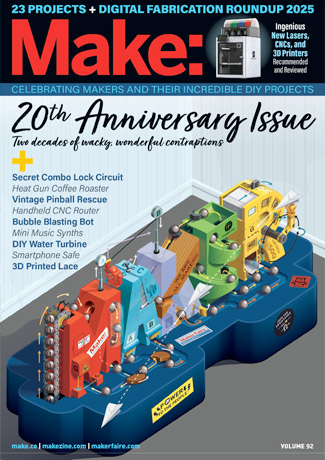








Twenty years ago, I wrote a column called “News from the Future” for the first issue of Make: magazine. I based it on the notion from science-fiction writer William Gibson that “The future is here. It’s just not evenly distributed yet.” Makers, hackers, hobbyists, and enthusiasts, I argued, are living in a future that we will all one day catch up to. The list of projects from early issues of Make: did indeed bring momentous news from the future. Drones, anyone? Ubiquitous wireless networking? Autonomous vehicles? Earth sensing? Biohacking?
Shoebox-sized satellites are now launched by the thousands from reusable launch rockets built by private companies. We increasingly get our internet, and soon, our phone service, from space. Elon Musk, the world’s richest man, has built his fortune on hardware innovation. Autonomous taxis are prowling the streets of San Francisco. Ukrainian naval drones have sunk Russian warships and driven their navy from the Black Sea. Homemade drones costing hundreds of dollars, often still assembled by hobbyists, are taking out multi-million-dollar Russian tanks. Artificial intelligences — not just humans — are hungry for new physical and energy infrastructure. Vast new solar and wind farms, and even nuclear — and perhaps fusion — power plants are coming on stream.
In today’s news from the future, the need for maker expertise has never been greater. The great challenges of the 21st century — climate change, pandemics, rising energy demands from artificial intelligence, crumbling 20thcentury infrastructure, vast geopolitical power shifts, mass migrations, and more — will not be solved by consumer internet applications, or even cutting-edge AI. They require engagement with the physical world. Inside every one of these challenges is an opportunity. But to talk of opportunity and the fever dreams of investors looking for their next big score is to miss the point. The purest explorations of new possibilities don’t just come from those looking to profit from them, but from those who are pursuing the new out of curiosity and the sheer joy of exploration.
To those motivations, we must add courage and the urgent spur of necessity. A recent story in the Kyiv Post about drone warfare in Ukraine highlights how important grassroots makers are to the defense of the country in its war for national survival:
“In order to feed the inexhaustible demand for drones, Ukraine churns out hundreds of them every day in shops, garages, mini-factories, and even individual apartments across the country. There is no central planning. … Civic action groups gather money [for] other civic action groups that build drones. Every once in a while, people decide the best way they can contribute to the war effort is to build some drones themselves.”
I hope that isn’t news from a dark future coming to more of the world, but it may well be. In any case, self-sufficiency, the ability to take things apart and put them back together, perhaps in a new way, reusing old devices to solve new problems, building new mechanical and electronic “bodies” to house artificial intelligence or extend human reach and perception — these are going to be essential skills for the future.
So don’t listen to people who tell you that the future belongs to kids who learn how to use AI better than their peers. Everyone is going to learn to use AI, just as everyone learns to use a smartphone today. But only some people will also still know how to get their hands dirty.
Make: is your home if you want to be one of those.
This article appeared in Make: Volume 92.

ADVERTISEMENT