



art

Making Furniture with Magnetism and Gravity

Making Furniture with Magnetism and Gravity

According to the bio on his website, Jólan van der Wiel admires objects which show experimental discovery and are translated into a functional design. His Gravity Stools demonstrate that perfectly. Using a custom magnetic material and a machine with large magnets to stretch the legs off the seat of the stool, he manufactures a product which is “characterized by the freakish and organic shapes that are so typical of nature itself.”

Scrap Tanker Car Becomes Giant Steel Mantis

Scrap Tanker Car Becomes Giant Steel Mantis

Bill Secunda’s sculpture “Mantis Dreaming” was inspired by The Verve’s song “Catching The Butterfly.” Of it, he writes: “I imagined a praying mantis might have that dream, his opposite, the butterfly, beautiful, delicate, and always out of reach. He is so infatuated with it, when the butterfly lands on him he stands frozen. His instincts clash with his fascination, all he can do is hope it doesn’t fly away.”

Zwischenräume Robotically Destroys a Living Room

As the artistic duo RoboCoco, Petra Gemeinboeck and Rob Saunders explain:

The installation embeds a group of autonomous robots into the walls of a gallery. They punch holes through the walls to inspect what’s outside, signal each other, and conspire. As if the walls had ears and a hammer to pierce holes for their eyes to see. The work develops a political relationship between the stealthy invasion of digital surveillance and urban combat tactics in which soldiers are instructed to walk through private walls. The installation stages this relationship in the form of an autonomous sculptural process that marks and wounds our environment, leaving behind open scars.

Topology Tuesday:  Klein’s Quartic

Topology Tuesday: Klein’s Quartic

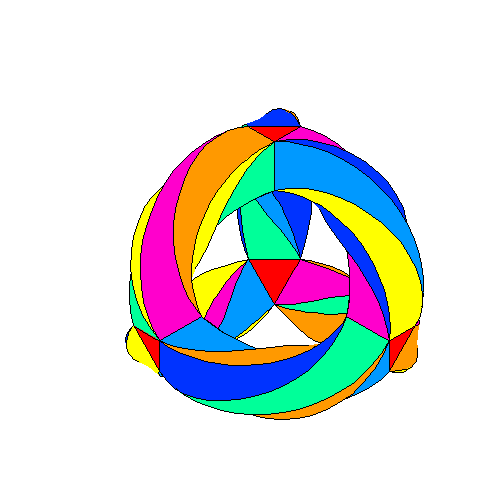
If you are looking for a subject likely to inflame the hearts of mathematicians, make them slightly weak in the knees, and induce some distinctly poetical sentiments, Klein’s Quartic, first described by German mathematician Felix Klein in 1878, seems like a pretty good bet. Though the surface itself, per Wikipedia, “does not have a (non-trivial) 3-dimensional linear representation,” several prominent math-bloggers have produced models, projections, and plain-language written explanations attempting – and doing a pretty good job of it, IMHO – to communicate their passion for the construct…