







Mouse Droid is the colloquial name for MSE-6, a small robot in the original Star Wars movie that looks a little like a toaster on wheels. Sabine Wren is a character from the show Star Wars Rebels who’s a prolific graffiti artist.
All caught up? Great.
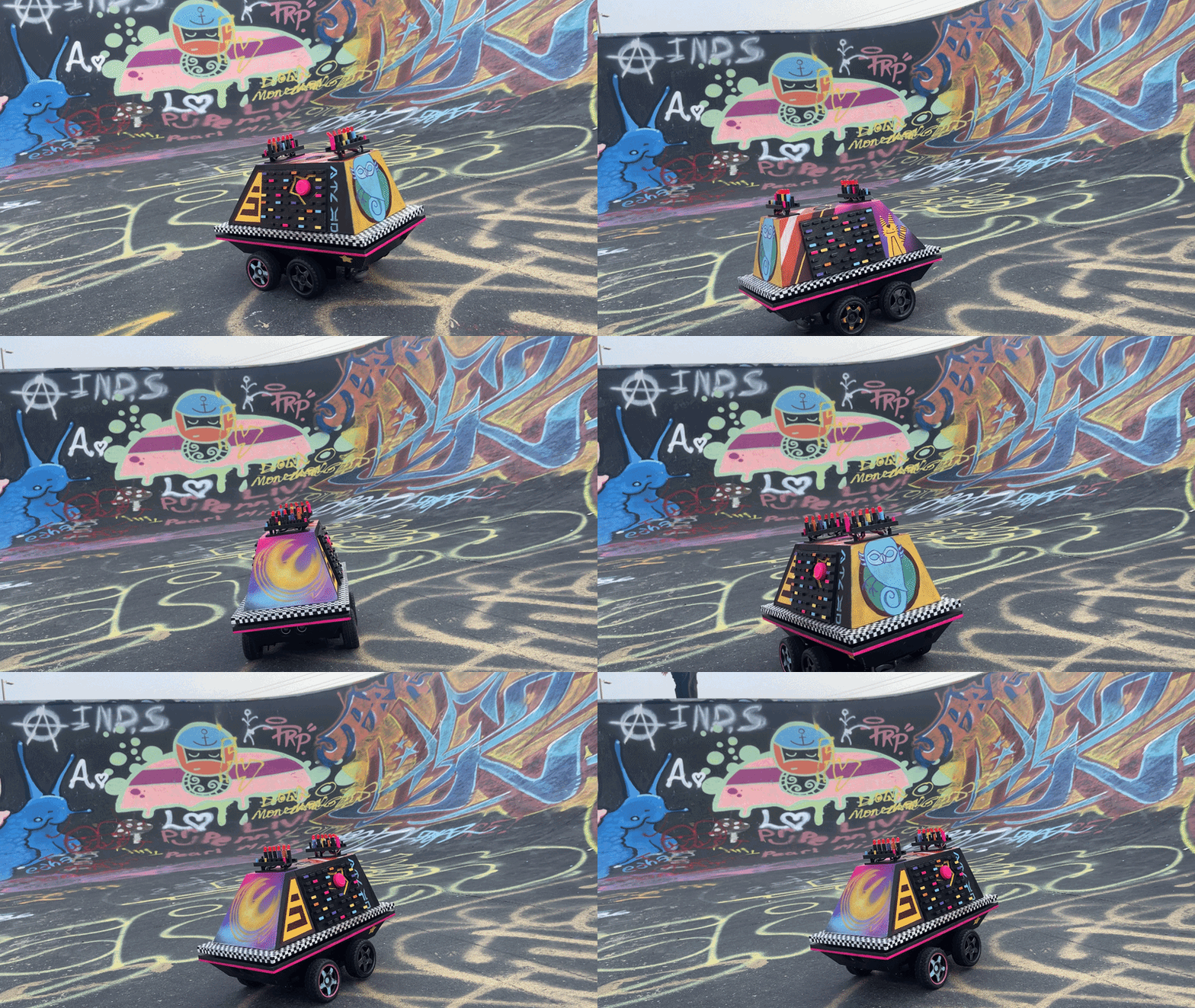
Cass (the Canadian maker behind Chaos Theory) is clearly a fan of both eras of the franchise, and wasn’t afraid to ask the important questions. What if an Imperial Mouse Droid got a makeover from Sabine Wren?
To find out the hard way, she built an open-source, fully autonomous, 3D-printed droid that abandoned its Imperial duties to become a graffiti-covered rebel rave machine.
It was a labour of love. It wasn’t enough to build a new shell around an existing vehicle. Cass’s droid had to be able to navigate fully autonomously. And react with a panic mode. And have a party button.
The brains in this case are an Arduino UNO, with a DFPlayer Mini MP3 on audio. Feeling around is brought to you by an ultrasonic distance sensor. And since those aren’t parts that typically come on a stock car, it made more sense to build one from scratch.

It is largely a custom chassis that I designed and 3D printed, although I did use an existing flat metal Mecanum chassis underneath it purely as a structural mounting point for the motors. It gave me something sturdy for the motors to screw into while I was developing the rest of the chassis. If I were to build a version 2, I would probably eliminate the Mecanum support entirely and mount the motors directly using brackets attached with heat-set inserts.
There is also a nice practical benefit to designing everything myself: it makes the project much more replicable. Someone else with a 3D printer can take the files and build their own version without having to track down a particular RC car or adapt an existing platform to fit.
And, honestly, there is a less-than-practical reason too: I just really enjoy building things from scratch! I enjoy pushing my skills wherever I can. This was my first foray into using heat-set inserts for attaching components to 3D prints, and I’m really pleased with how well they worked in this case.
If that isn’t a good enough reason to build something, I don’t know what is.

See how to build your own over on Instructables.

ADVERTISEMENT