










DIY Hardware shredder…?
 MAKE reader Matthew writes “I woud like to suggest a make project to design and build a hard drive/electronics shredder, not one to shred software but something to shred actual metal hard drives, they have commercial versions. The end product can be recylced.” Awhile back there was a round up on G4’s Destroy All Data and I’ve also seen this company and their crazy couch shredding, computer devouring videos, as far as DIY solutions – how about a hard drive clock? Post suggestions in the comments!

 Steve writes “Here’s how to make a soda-can Van de Graaf generator. This site contains detailed directions for making a simple Van de Graaf generator with a soda can, some PVC pipe and a few simple everyday components. The site even features a picture of the finished product in action.”
 Nice mod, adding Bluetooth to laptop with an extra USB port…TomTheGeek writes “This weekend I added internal bluetooth to my Dell CPx laptop. These laptops have a two port USB hub in them but only one is available on the outside. The other one is only used if you have a docking station. Since I don’t have a docking station I found the traces for the unused USB port and placed my USB bluetooth module internally. These are the connections I had to add to the main board in order to use the USB port…”
 “A laser harp is basically a big frame resembling a real harp. There are no strings. Instead, beams of laser light are projected from the bottom of the harp. These beams strike light sensors at the top of the frame. When something (a hand, foot, etc.) blocks the beam, a note is triggered on a synthesizer or some type of tone generator. Theoretically the harp could control anything but I’m interested in its musical possibilities.” Here’s how to make one! [
 In
In 
 Andreas writes “I don’t know how, but late at night I got the idea that I wanted to covert my new 3D cell Mag-Lite to a handy photo-lamp. Next morning I dug out some 250 GSM paper and some adhesive foil I’ve been saving for a worthy project and whipped up a quick ghetto-lamp…It’s not all that powerful, but it’s great for macro shots and softening hard shadows, and it’s very portable. Think of this as a beta version, I’ll likely improve the design a bit once christmas is over. The basic concept is sound, I think there’s potential for more if I sort out a proper parabolic reflector for it.” Thanks
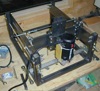 Jonathan designed a great printed circuit board router, he writes – “Printed circuit boards are usually manufactured by chemical etching (with iron (III) chloride or ammonium persulfate, for example). This is not very practical if only a few boards are necessary, because these etchants are messy and somewhat dangerous. PCBs can also be manufactured by “mechanical etching,” in which a trace is “etched” by milling away the copper along its perimeter. This requires software to generate a toolpath from the layout and a small CNC mill or router. Lots of companies make routers for PCB fabrication, but they are unjustifiably expensive so I decided to build one.”