









HOW TO – The Magic Phone, Part 2
 Here’s part 2 of Fabienne Serriere’s great rotary phone to cell phone project “This week we bring you Part 2 of The Magic Phone How-To: The Circuit. The Magic Phone is a project where both a DECT compatible wireless home phone and a GSM cellphone are placed inside an old rotary phone. In Part 1 of the How-To, we showed you how to reverse engineer the matrix on a phone circuit.” Link.

 Chris writes “Considering how many people bought the HP Bluetooth stereo headphones and got disappointed when the headband snapped, I thought that it was time to do something useful with the ‘broken’ headphone. We’ll take you through all steps of dismantling the Bluetooth receiver and building it into a nice mouse housing with 12v in and line out. And as the device keeps its battery, you can also use this as a portable Bluetooth stereo receiver and plug in you high quality headphones or even connect it to your stereo at home.”
 “In the November 1999 issue of EPE (Everyday Practical Electronics), a small and intriguing circuit was published in the Ingenuity Unlimited section by Z. Kaparnik. It was a very small implementation of a typical transformer feedback single transistor invertor. The transformer was a standard ferrite bead with two windings wound on it and the circuit was using the high voltage pulse generated when the transistor turns off to light an LED from a single 1.5V battery. This page has two variations on the original design to use the simple circuit in a useful manner.”
 Big Blue Saw is a new site that lets you create parts out of metal or plastic. You use your favorite CAD program to design a part, then upload the design to their site to get a rendered 3D image, and a quote. From the site: “Big Blue Saw is a new concept which brings together the Internet with modern computer controlled rapid manufacturing. With Big Blue Saw, takes a design you have made on your computer, then turns that design into a objects using state of the art robotic machine tools. Your parts are delivered right to your door.”
 If you happen to have an Xbox 360 and a PSP you can indeed use them together. It’s pretty much what you’d expect, the PSP acts as a USB drive and the Xbox 360 can play / browse music and photos. Video isn’t supported yet, but it’s a start… [
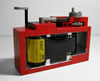 Overview of the 35mm LEGO Camera – Adrian writes “Last night I tackled the project of a 35mm version of my medium format pinhole Lego camera. It turned out to be easier than I expected. I should probably have spent the time making better instructions for the medium format version, but rest assured, those are in the works. Anyway, here are a couple highlights of this camera’s design that are different from the medium format version…” Thanks Richard!