





Math Monday: Stained Glass Polar Zonohedron
Stained glass can be used to make many mathematical forms. One very beautiful shape is the polar zonohedron. Hans Schepker made this three-foot diameter example from hundreds of pieces of stained glass.
DIY science is the perfect way to use your creative skills and learn something new. With the right supplies, some determination, and a curious mind, you can create amazing experiments that open up a whole world of possibilities. At home-made laboratories or tech workshops, makers from all backgrounds can explore new ideas by finding ways to study their environment in novel ways – allowing them to make breathtaking discoveries!

Stained glass can be used to make many mathematical forms. One very beautiful shape is the polar zonohedron. Hans Schepker made this three-foot diameter example from hundreds of pieces of stained glass.

My family and I went to the wonderful NASA Jet Propulsion Laboratory (JPL) Open House this weekend. Among the many fascinating sights they shared with the public, this was our favorite. The mobility test platform for the Curiosity rover. With its rocker-bogie passive balance suspension system, this bot does not consider large rocks to be much of an obstacle. At 20″, its wheels are twice the size of those of its predecessors, including the forever-stuck Spirit. Plus, there was a woman from JPL controlling it from an iPhone.

We have covered septuagenarian Palestine, TX, resident Pat Delany’s DIY multimachine, which is mostly built from recycled auto parts, before. Following on the success of that design, Pat has branched out, researching and promulgating three more simple build-it-yourself tool designs: A treadle-powered electrical generator, a simple compound lever drill press, and—most interesting to me—a lathe made from cast concrete and aligned with wedges sawn flush after the concrete has set up. Engineering for Change has a good overview of the story and the available online resources. [Thanks, Jake!]
This is a crafty and eco way to create holders for your earbuds out of an old credit card.

If you want to apply a maker’s mark or other repeated pyrograph to wooden goods, but can’t justify the expense of a custom branding iron, a practically identical effect can be achieved by applying a strong solution of ammonium chloride, for instance using a foam rubber stamp, followed by relatively mild heat.
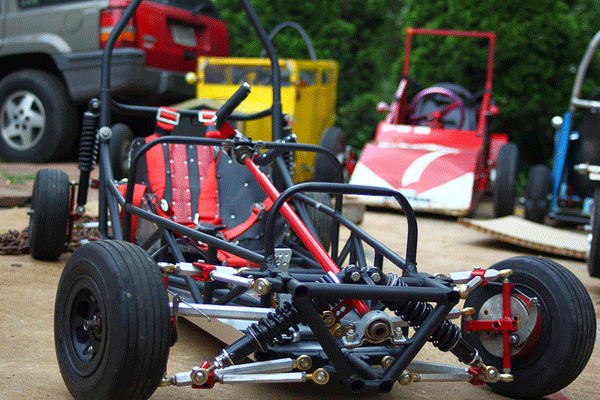
Leading up to MAKE Volume 26, we ran a fun and simple Karts and Wheels Contest. The basic criteria was that entries had to have wheels, be able to carry a person, and the build was to be documented with images and step-by-step instructions in our projects wiki, Make: Projects. We got some great entries, […]
I have monograms on the mind and came across this unique spin on the idea using recycled wine corks on this eco-friendly blog, Green is Universal.