





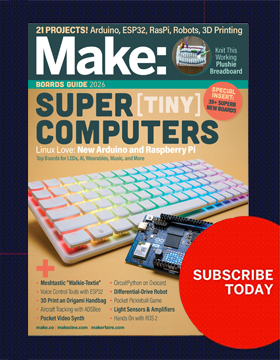

![Cover of Make Volume 95. Headline is "Super [Tiny] Computers". A Raspberry Pi 500+ with RGB lights and an Arduino Q board are on the cover.](https://i0.wp.com/makezine.com/wp-content/uploads/2025/10/M95_Cover_promo.jpeg?resize=150%2C213&ssl=1)
I remember getting my first Arduino in 2007 (a Diecimila “Prototype Limited Edition”), excitedly plugging it into my computer, and programming it as a brain transplant for my Roomba (thanks, todbot!). I vividly recall the arrival of my first Raspberry Pi (Model B, code 2, with just 256MB of RAM!), and my Automotive EE friends making fun of it for using an SD card for storage, which they estimated would wear out after a year or two. These devices allowed me to harness my computer to write code for devices I could touch, rather than being trapped in a screen or on a server.
The Pi was a single-board computer (SBC) but it wasn’t really powerful enough to use as a desktop, versus SSHing in remotely to interact with it (though that interaction would give me the confidence to eventually switch to Linux as my daily driver.) Still, the Pi kept getting better, so I excitedly tested each iteration as a daily driver itself, with the Raspberry Pi 3 Model B+ just starting to tease at viability, then the 4 being reasonably serviceable, and finally the 5 doing an extremely convincing job. Meanwhile, 2020’s Pi 400 tickled me with its all-in-one keyboard form factor (reminiscent of my beloved BBC Master breadbin).

But it’s the new Raspberry Pi 500+, featured on the cover of our newest issue, that brings together the power and utility, for the true embodiment of that “plug it in the telly and go” experience that made me fall in love with computers in the first place. No flashing SD cards, no faffing about with a million cables, just HDMI, USB-C power, a mouse, and a whole universe of learning and entertainment at your (RGB-bathed) fingertips.

Raspberry Pi might be the big name in SBCs, but out of absolutely nowhere, Arduino, newly acquired by Qualcomm, blew our minds with the new Uno Q, an SBC that asks “What would Xzibit do if he designed a dev board?” The obvious answer: they put an Arduino in your Arduino, so you can program your Arduino MCU while you program with your Arduino SBC. In short, in 2005 you programmed your Arduino with a computer; in 2025 your Arduino is the computer!
Looking back at our boards coverage in recent years, the supply chain disruptions that threatened the whole ecosystem now feel like a distant memory, and a thriving environment of innovative and specialized boards has emerged (see Make: Guide to Boards packaged with Make: Volume 95!). But new threats loom, in the form of unhinged, unpredictable tariffs, which impinge on almost every niche interest, hobby, and small business. While amassing dozens of boards this year to inform our guide, I received a $365 bill from DHL due to products being incorrectly marked (I was able to refuse it and receive the goods duty-free upon re-shipping), and another $56 surprise that I ended up having to pay in the interest of time. And these are boards I receive for free! Small businesses and makers who need to procure items from overseas are hurting and in many cases giving up, at least until things stabilize or become saner. (See my coverage of TariffsAreBullshit.com in the Make Things newsletter.)
We’re seeing MicroPython and CircuitPython emerge as first-class citizens with newer boards, rather than an afterthought or hack, with the Arduino Uno Q’s new App Lab throwing desktop Python into the mix too, and directly interfacing it with traditional sketches. LoRa, well over a decade old, is having a banner year thanks to Meshtastic, which utilizes the long-range radio networking protocol to create an encrypted off-grid messaging system. And two ultra-affordable microcontrollers keep bringing us fantastic projects: the RP2040 and the ESP32 (see our full coverage in Make: Volume 95).
Our Guide to Boards is evolving too, with new music and cosplay board specialists joining some familiar returning authors. As always, I’m keen to hear your feedback on our choice of boards and categories — get in touch at editor@makezine.com and let me know your favorite new and upcoming boards, and your predictions for next year!
This article appeared in Make: Volume 95.

ADVERTISEMENT