Handy how to from Bob Bilson on Instructables “Need to ship out something, but you don’t have a shipping box? Check out the copy machine. Grab an empty copy paper box and follow these instructions.”Link.
Nice outdoor webcam installation – “…the final webcam installation including painting to comply with our homeowners’ association. You may need a stepladder and a piece of cardboard to “frame” (as a movie director might) your intended view from a workable location in space. If you’re lucky, you just attach your cam housing to an existing surface. Get a sense of the angle of coverage afforded by your camera before you do this. High school geometry and its study of triangles may be finally useful to you here.” [via] Link.
Mac writes “A while back, I happened upon the application note “Interface to Optical Mouse Sensor” on the Kronos Robotics website. It discusses the use of a sensor from an optical mouse for use in position sensing coprocessor on a robot. The application note did not go beyond the proof-of-concept stage. That is, could the sensor be directly interfaced and controlled? Since I didn’t have easy access to the GE mouse described in the application note, I wanted to see if there were other optical mice available that had an Agilent optical mouse sensor, which I could use in its place. I also wanted to go beyond the proof-of-concept stage and acutally use an optical mouse sensor in a robotics application. Before developing that application, though, I first needed to gain familarity with interfacing to the optical mouse sensor in a Forth environment. This webpage describes the hack I did to a BTC optical mouse to enable direct control of the Agilent (now Avago, see below) ADNS-2610 Optical Mouse Sensor and the Forth code written to control it.” [via] Link.
This is a really clever idea, burn images along with the data on a CDR… Instructable maker Argon writes – “By carefully choosing the right 1s and 0s to burn to a CD, it is possible to burn visible images on normal CD-Rs. These images rely on the fact that the 1s and 0s created by pits in the CDs surface reflect light differently.” Link.
Here’s this week’s “cool stuff being made!” – “…animation of the making of a flat panel display. In fact, you’re probably looking at one now. This shows you how once again you are surrounded by manufactured products: cars, food, clothing, flat panel displays. Without manufactured products, the world would be a quiet and empty (and hungry) place.” [via] Link.
Jake posted up an Instructable for our mousebot “Mousebot from Make vol 2 is a fun introduction to robotics. So fun that I’ve created this expanded documentation of a Mousey build from start to finish, with a few extra little tips you won’t find in the mag. This how-to is best understood after reading the original article from page 100 of Make vol 2 however it is probably not required. Mousebot is a simple bot that uses two “eyes” to sense light and then turns towards the light. A single large “whisker” is mounted on the front of the mouse to detect collisions.”Link.
Matthew writes “A project I’m finishing off involves a simple little front end that I’ve decided to implement using some DHTML. As I was reading up on JavaScript’s setTimeout method as part of my DHTML research, an interesting thought crossed my mind: would it be possible to make a strobe light out of that old archaic CRT monitor sitting on my closet floor and such a weak (as in weakly typed) language as JavaScript? Well, I decided to give it a try and it actually worked out pretty well — although it did give me a mild headache after I had the not so keen idea to stare directly at it for a few seconds. Here’s the code you need to make use of that old dust magnet.”Link.











 Handy how to from Bob Bilson on Instructables “Need to ship out something, but you don’t have a shipping box? Check out the copy machine. Grab an empty copy paper box and follow these instructions.” Link.
 Nice outdoor webcam installation – “…the final webcam installation including painting to comply with our homeowners’ association. You may need a stepladder and a piece of cardboard to “frame” (as a movie director might) your intended view from a workable location in space. If you’re lucky, you just attach your cam housing to an existing surface. Get a sense of the angle of coverage afforded by your camera before you do this. High school geometry and its study of triangles may be finally useful to you here.” [
 Mac writes “A while back, I happened upon the application note “Interface to Optical Mouse Sensor” on the Kronos Robotics website. It discusses the use of a sensor from an optical mouse for use in position sensing coprocessor on a robot. The application note did not go beyond the proof-of-concept stage. That is, could the sensor be directly interfaced and controlled? Since I didn’t have easy access to the GE mouse described in the application note, I wanted to see if there were other optical mice available that had an Agilent optical mouse sensor, which I could use in its place. I also wanted to go beyond the proof-of-concept stage and acutally use an optical mouse sensor in a robotics application. Before developing that application, though, I first needed to gain familarity with interfacing to the optical mouse sensor in a Forth environment. This webpage describes the hack I did to a BTC optical mouse to enable direct control of the Agilent (now Avago, see below) ADNS-2610 Optical Mouse Sensor and the Forth code written to control it.” [
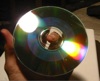 This is a really clever idea, burn images along with the data on a CDR… Instructable maker Argon writes – “By carefully choosing the right 1s and 0s to burn to a CD, it is possible to burn visible images on normal CD-Rs. These images rely on the fact that the 1s and 0s created by pits in the CDs surface reflect light differently.”
  Here’s this week’s “cool stuff being made!” – “…animation of the making of a flat panel display. In fact, you’re probably looking at one now. This shows you how once again you are surrounded by manufactured products: cars, food, clothing, flat panel displays. Without manufactured products, the world would be a quiet and empty (and hungry) place.” [
 Jake posted up an Instructable for our mousebot “Mousebot from
 Matthew writes “A project I’m finishing off involves a simple little front end that I’ve decided to implement using some DHTML. As I was reading up on JavaScript’s setTimeout method as part of my DHTML research, an interesting thought crossed my mind: would it be possible to make a strobe light out of that old archaic CRT monitor sitting on my closet floor and such a weak (as in weakly typed) language as JavaScript? Well, I decided to give it a try and it actually worked out pretty well — although it did give me a mild headache after I had the not so keen idea to stare directly at it for a few seconds. Here’s the code you need to make use of that old dust magnet.”