










HOW TO Water-cool your PC

Two parts water, one part coolant, and one part guts are all it takes to water-cool your PC. It may seem a little extreme for a garden-variety desktop, but if your CPU runs hot or you’ve overclocked parts of your system, nothing beats the cooling power of classic H2O. Water conducts heat far better than air, and you don’t have to be a turbogeek to perform the conversion. Modern kits make installation little more challenging than swapping a fan or a heat sink. [via] Link.

 MAKE Creative Director David Albertson shared some of his fav tools with me – and now I’m sharing them with you! Not the latest gadgets, but two of my favorite tools are an
 Open up a copy of google talk on all computers with which you wish to conference. After one copy is opened make a new shortcut for google talk but at the end of it add /nomutex. If you installed it to the default folder then your shortcut should read “C:Program FilesGoogleGoogle Talkgoogletalk.exe” /nomutex. Open 2 instances of the software on every user’s computer. After this start a chain: User 1 should connect on one instance to user 2. User 2 will connect on his second instance to user 3. User 3 will connect using his second instance back to user 1. With this chain everyone is connected to everyone. [
 Hydroman writes “You might say I am a shade-tree scientist. I am doing a research and development project of my own. I am making hydrogen from beer cans, water and sodium hydroxide. Visit my website to see the plans, watch the videos and leave comments in the forum. I had a lot of fun making the videos. This is an opensource project. Join in the fun!”
 Railfans are building life-size, full-scale railroad cabs that look and function like the real thing, then projecting scenery onto their wall. And for music, you can hack their USB controller to turn it into a music / video / VJ controller, using either the Windows SDK (for hard coding) or a Mac app called junXion (for simple MIDI, useful with Max/MSP/Jitter, audio and VJ apps etc.) Aside from the train controller interface, you could use their I/O box to build any controller you wanted. There are other I/O boxes that use USB, but theirs has an unusual number of ins and outs, saving you basic stamp programming. And it’s also comparatively cheap. They also make bunches of custom controllers, keyboards, everything…
 Neat lamp a MAKE Flickr pool member made – the base and top are poplar, while the dowels are oak. I used very small dowels to hold the base together (you can barely see them as spots near the bottommost CD). The bottom two layers of the base are hollow, and there’s a piece of round plexiglass to hold everything in. The light is a standard cold cathode tube used for case modding. This thing is freakin’ heavy, since there’s over 200 CDs.
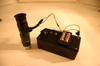 This is a really cool attempt for a DIY image intensifier- MAKE Flickr pool member BenSinclair writes “I took a Bushnell night vision monocular and crammed it into an eyepiece for use as an image intensifier on an astronomical telescope. Unfortunately, it just doesn’t improve the image enough”.