










Create Teeny Tiny Solar Insect Robots
One of the great things about these little bots is that you can make them from scavenged materials. Use parts from broken electronics and bring them back to life as little robots!
DIY science is the perfect way to use your creative skills and learn something new. With the right supplies, some determination, and a curious mind, you can create amazing experiments that open up a whole world of possibilities. At home-made laboratories or tech workshops, makers from all backgrounds can explore new ideas by finding ways to study their environment in novel ways – allowing them to make breathtaking discoveries!

One of the great things about these little bots is that you can make them from scavenged materials. Use parts from broken electronics and bring them back to life as little robots!

John Park hacks a Wii controller and turns it into a personal flight recorder that can sense and measure the stomach-churning G forces of roller coasters and other high-speed, high-risk activities.

The beating of the heart is often recorded via sound or simply with touch – but there’s also another interesting and somewhat lesser known option – light. An infrared emitter/detector pair can be used along with a programmable microcontroller, to effectively visualize the effects of the human body’s hardest-working muscle.
http://blog.makezine.com/archive/2009/11/collins_lab_infrared_heart_sensor.html
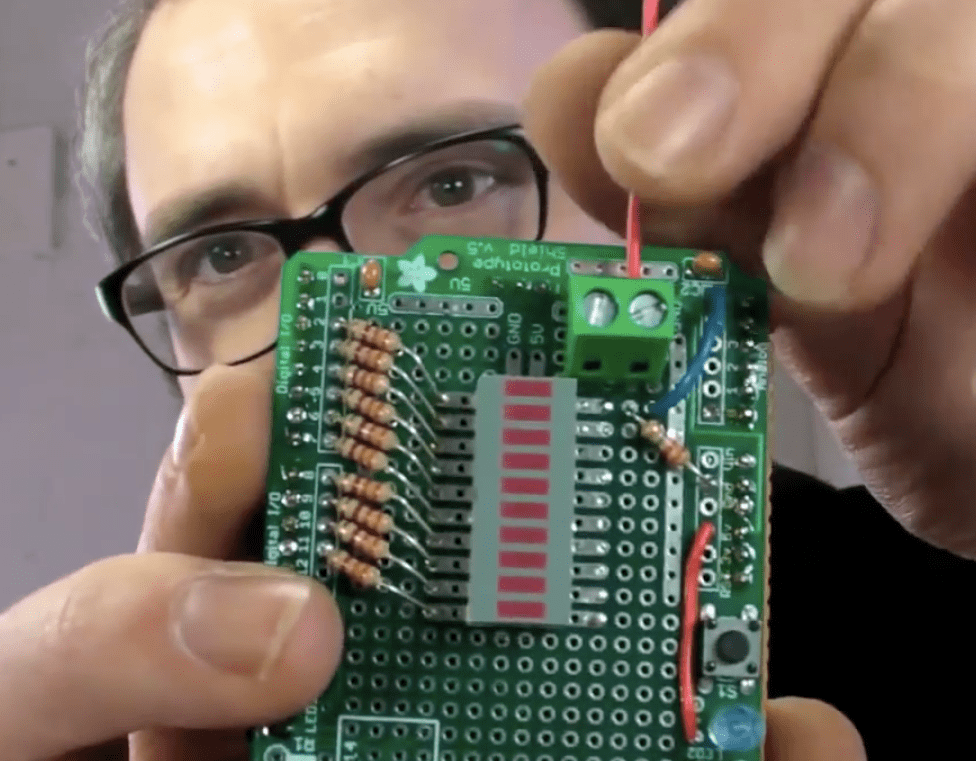
Use an Arduino microcontroller to sense invisible electromagnetic fields using wire, a resistor, and an LED.

A Penrose tiling (Wikipedia), named for British mathematical physicist Sir Roger Penrose, who investigated them in the 1970s. A Penrose tiling is “aperiodic,” or, simply put, produces a pattern that does not repeat itself no matter how far you extend it across the plain. All Penrose tilings are aperiodic, but not all aperiodic tilings are Penrose tilings.
Lots of bright creative folks have installed custom Penrose tile floors. Here’s a selection of a few of my faves from around the web. I couldn’t find anybody online who’s selling pre-cut Penrose prototiles, so it looks like anybody who wants to do it themselves has to cut their own. Or, if somebody is feeling entrepreneurial…

Stamatios M. Krimigis of the Johns Hopkins University Applied Physics Laboratory is pictured with the Voyager spacecraft’s backup flight unit which was never used. (Jed Kirschbaum, Baltimore Sun/January 17, 2011) So cool. Thanks to Michael Doyle for posting this on Facebook. Last June, Krimigis’ team noticed that solar particles had stopped striking from behind, and […]
Scan a laser across a phosphorescent screen to create glowing, haunting images that slowly fade into blackness.