










My 10 Favorite Mechanical Animations from Wikipedia
My ten favorite mechanical animations from Wikipedia.
DIY science is the perfect way to use your creative skills and learn something new. With the right supplies, some determination, and a curious mind, you can create amazing experiments that open up a whole world of possibilities. At home-made laboratories or tech workshops, makers from all backgrounds can explore new ideas by finding ways to study their environment in novel ways – allowing them to make breathtaking discoveries!
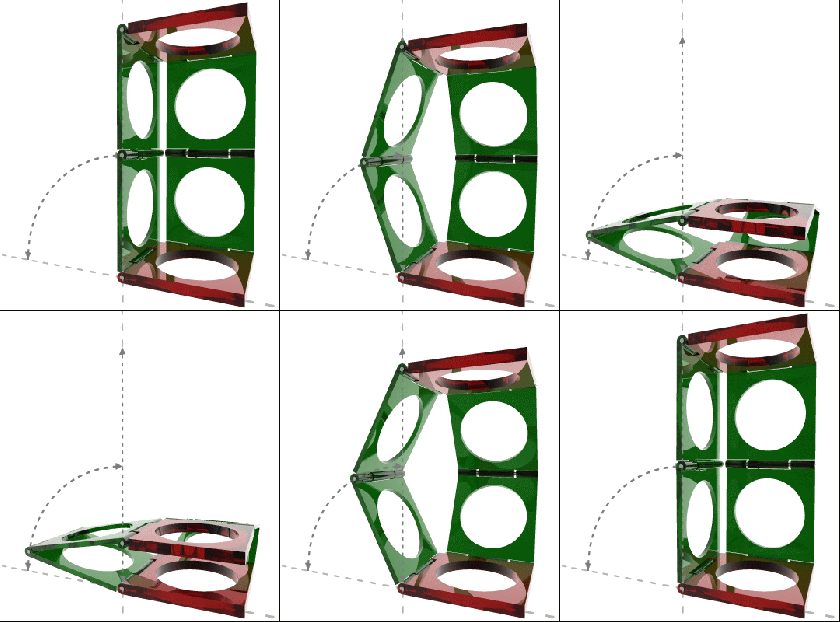
My ten favorite mechanical animations from Wikipedia.

This free web-based tool generates your text as a fold-up extruded 3D origami model. It’s based on this paper from Erik Demaine, Martin Demaine, and Jason Ku at the MIT Computer Science and Artificial Intelligence Laboratory. [via Boing Boing] More: Joel Cooper’s amazing origami masks plus grid tutorial Origami model + reflection = skull Gorgeous […]

Some observations: The table top pieces are only truly circular in their larger arrangement. In the “contracted” table, the 6 wedges in fact form a kind of rounded-off hexagon, and the outer table edge is made circular by the rotating rim, which has a complementary inner profile. Besides the wedges, there are two other types of pieces that make up the table top–6 “darts” having two parallel sides that rise to fill the spaces between the wedges, and the “star” (a dodecagram, in fact) that rises up in the middle. The table is locked in either configuration by one or more threaded detents which are quite clearly shown in the upper video.

Michael Colombo has been experimenting with recycling plastic bags, them into children’s blocks.

By George Hart for the Museum of Mathematics With paper and scissors and patience, you can make an amazing variety of mathematical forms. The paper sculpture below consists of twenty identical components that form a complex linkage. They lock together without glue in a very symmetric arrangement. If you want to try this, the template […]
Jeri experiments with Dupont Luxprint Electroluminescent inks and converts an old LCD into a simple EL display. She also demonstrates that super glue can be used as the dielectric and that zinc sulfide glow powder does not work well as an EL phosphor. More: Jeri’s homemade pinball machine MacGyver of the Day: Electronics Hacker Jeri […]

I’m guessing the electrical potential used to charge the battery during the day is generated between the top and bottom of the algal layer and is ultimately due to a gravity-induced concentration gradient of some kind of metabolite in the broth.