










Harnessing bacteria to turn gears
This looks neat, a team of scientists from the Argonne National Laboratory and Northwestern University have figured out how to get bacteria to spin tiny gears.
DIY science is the perfect way to use your creative skills and learn something new. With the right supplies, some determination, and a curious mind, you can create amazing experiments that open up a whole world of possibilities. At home-made laboratories or tech workshops, makers from all backgrounds can explore new ideas by finding ways to study their environment in novel ways – allowing them to make breathtaking discoveries!

This looks neat, a team of scientists from the Argonne National Laboratory and Northwestern University have figured out how to get bacteria to spin tiny gears.

Happy holidays from the Universe… Just in time for the holidays: a Hubble Space Telescope picture postcard of hundreds of brilliant blue stars wreathed by warm, glowing clouds. The festive portrait is the most detailed view of the largest stellar nursery in our local galactic neighborhood. The massive, young stellar grouping, called R136, is only […]

Built by Associate Professor Yojiro Ishino of the Nagoya Institute of Technology, this giant camera took six months to build and has reportedly been certified by the Guinness Book of World Records as the camera with the record-holding highest number of lenses. It’s about 3 inches high and 18.5 inches across, and was built to study flames by capturing them simultaneously from as many angles as possible. [via Neatorama]

Researchers from Delft University of Technology have assembled inexpensive alternatives to costly scientific sensors using the Nintendo Wiimote.

It’s not that OS that you’re not using… it’s VISTA, an amazing new telescope via Wired A new telescope — VISTA (the Visible and Infrared Survey Telescope for Astronomy) — has just started work at ESO’s Paranal Observatory and has made its first release of pictures. VISTA is a survey telescope working at infrared wavelengths […]

From the Chromoscope intro: Ever wanted X-ray specs or super-human vision? Chromoscope lets you explore our Galaxy (the Milky Way) and the distant Universe in a range of wavelengths from X-rays to the longest radio waves. Seen above is an image in visible light and in radio waves (408 MHz) [via Tim O’Reilly’s Twitter feed]
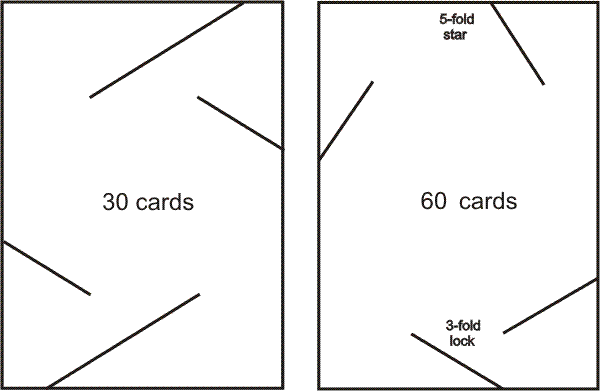
Playing card constructions By George Hart for the Museum of Mathematics At The Math Museum, we think it’s important to challenge oneself with mind-expanding tasks. Here are two rather challenging constructions which look simple, but may stymie you for hours. When you’re done, you’ll have something unique to show your friends. The ball at left […]