










Furoshiki how-to
Here’s an Instructable and video on Furoshiki, the Japanese art of cloth-folding to make various bags, carry-alls, and sacks. Paper, Plastic, or Furoshiki?
DIY science is the perfect way to use your creative skills and learn something new. With the right supplies, some determination, and a curious mind, you can create amazing experiments that open up a whole world of possibilities. At home-made laboratories or tech workshops, makers from all backgrounds can explore new ideas by finding ways to study their environment in novel ways – allowing them to make breathtaking discoveries!
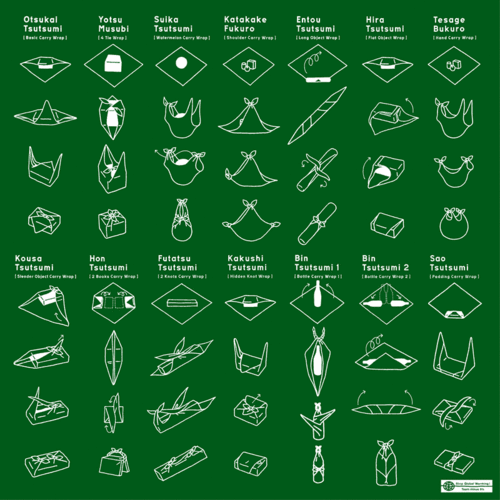
Here’s an Instructable and video on Furoshiki, the Japanese art of cloth-folding to make various bags, carry-alls, and sacks. Paper, Plastic, or Furoshiki?

Seed Magazine posted an interesting photo series documenting scientific laboratories after dark. Describing the top photo above – Much of the fundamental knowledge that underpins our search for extraterrestrial life and supports our understanding of our solar system’s history and evolution emerges from this small room in Theodor Kostiuk’s laboratory. On the rightmost table, infrared […]
Reuse a crashed hard drive or two for a set of wind chimes. Easy to make and sound great. Thanks go to Thomas Arey for the original article in Make Magazine. To download Hard Drive Wind Chimes MP4 click here or subscribe in iTunes. Check out the Hard Drive Wind Chimes article MAKE 12 “Hard […]

Reuse a crashed hard drive or two for a set of wind chimes. Easy to make and sound great. From Make Volume 12 by Thomas Arey. View the PDF
Here’s part two of BBtv’s tour of the TCHO chocolate factory that David covered in his Proto column in MAKE Volume 14. I love the way they’ve bodged together village tech, Home Depot specials, and high-tech components to create machines and sensors for a few thousand bucks that would cost tens of thousands on the […]

The “Rug-Bug BEAM Photovore” by Ken Hill is an environmentally aware photovore robotic bug that rolls, creates chirping sounds in response to light levels, and can be charged with solar cells. The bot runs from a pair of 74ACT139 ICs to control two Hankscraft gear motors from pulsed signals and a dual 556 timer IC. […]

Well, they could use it for power. Physorg writes that Argentine scientists are capturing cow farts in plastic backpacks to try to understand the impact it has on global warming. They think that “30% of Argentina’s total greenhouse gases could be generated by cattle.” They’re experimenting with feeding clover and alfalfa instead of grain – […]