










Hack Glowing Cells: This Saturday at BioCurious
This is the “Hello World” of biotech. You will make cells that glow! Adding jellyfish genes to bacteria might sound like it’s complicated, but it’s easy!
DIY science is the perfect way to use your creative skills and learn something new. With the right supplies, some determination, and a curious mind, you can create amazing experiments that open up a whole world of possibilities. At home-made laboratories or tech workshops, makers from all backgrounds can explore new ideas by finding ways to study their environment in novel ways – allowing them to make breathtaking discoveries!

This is the “Hello World” of biotech. You will make cells that glow! Adding jellyfish genes to bacteria might sound like it’s complicated, but it’s easy!

Being someone who already suffers from a debilitating form of arthritis, and spends most days and nights tap dancing on a keyboard, I’m amazed that I haven’t developed some form of RSI (repetitive strain injury), the catch-all term for the cumulative chronic “micro-injuries” associated with repetitive movements and work fatigue. I don’t have chronic RSI, but I do get intense wrist pain sometimes, associated with my arthritis, and occasionally, little shooting nerve pains (which always make me wonder if RSI has finally befallen me). But for the last 14 years I’ve employed a faithful tool in helping me avoid aches and pains in my hands: Handeze Therapeutic Support Gloves.

MAKE has covered Berlin-based artist Benoît Maubrey prior work on Audio Ballerinas. Now he has created a similar, but stationary sculpture using over 1000 repurposed speakers. It’s called “Speakers Wall” and in the center is a genuine piece of the Berlin Wall. It has become something of a speaker’s corner for remote museum attendees who can call in and talk through a set of the speakers for 3 minutes. As an added bonus, the speakers are used as a PA system for DJs during concerts – I can only imagine what that would sound like.
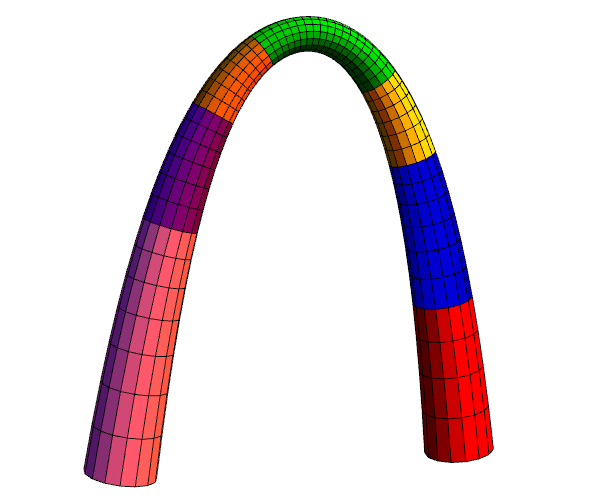
Here is a seven-piece arch in the shape of a catenary, similar to the Gateway Arch in St. Louis. If you have access to a 3D printer, you can make the pieces using the files available here.

YouTuber HouseholdHacker shows just how simple a glycerin-based fog machine really is, in principle, and how easy is it is to improvise a pretty fair substitute with some food-grade glycerin, a candle, and a couple other odds ‘n’ ends.

In the comments to an old post that Becky did in 2009, about Instructable user brokengun single-engine single rotor wind turbine (pictured above), a maker from India is trying to build a similar turbine and having problems.

Collin Purrington offers some great tips on the necessity of maintaining a laboratory notebook. While directed mainly at scientists, I could see it applying to anyone interested in Open Source Hardware development or simply working on difficult, long-term projects. [Via @cenmag] In the Maker Shed: Pick up The Maker’s Notebook ($19.99) for all your big […]