



Tinydino: World’s Smallest Arduino Clone?
Jaanus Kalde has made an Arduino clone that’s just 7.4 mm square. He used the ATmega88 chip and built the rest of the components around it.
As the preeminent tool for makers, Arduino is a versatile platform that covers almost every type of creative making. With its simple-to-use coding language and fun programming concepts, Arduino enables users to create modern electronics with ease. From beginner level projects like flashing LED lights to more advanced builds such as interactive robots, there are an endless number of possibilities when it comes to building projects with Arduino. Whether you are new or an experienced builder in search of fresh ideas, these posts will provide interesting Arduino tutorials and unique ideas that may spark your creativity and motivate you take on any type of maker project!
Jaanus Kalde has made an Arduino clone that’s just 7.4 mm square. He used the ATmega88 chip and built the rest of the components around it.
This video is a vey basic introduction to the Arduino. So if you have a friend or relative who has been asking “what’s an Arduino?” You can point them here. They’ll get an overview of what it is and what’s possible with it.
http://www.youtube.com/watch?feature=player_embedded&v=KqCLeRHehP4
We’ve seen many examples of floppy and hard disk drives being sequenced to make music, but the Moppy can be controlled by an external keyboard. Sammy1am created the Moppy using and Arduino UNO and some stepper motors to set the frequencing of the spinning disk drives.
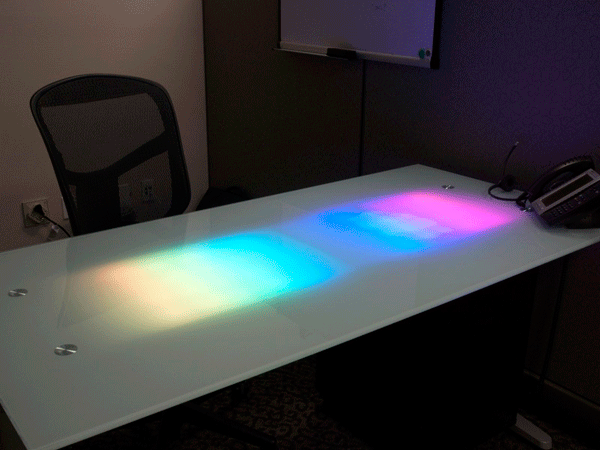
San Diego-based software engineer Michael LaGrasta brought his DeskLights ambient notification system to Maker Faire Bay Area this year, where I had the chance to meet him. In a nutshell, using an Arduino Uno Ethernet and 160 RGB LEDs (in the form of Adafruit’s Pixels, “the desk receives event notifications over the network and alters […]
Ben Hollis and Eva Funderburgh chose an unusual material to house their Arduino in: clay. Glowback, the little creature they’ve created, has nodules on its back made of transluscent porcelain. The porcelain gives off a soft glow in staggered rhythms provided by the super bright LEDs underneath the nodules.
follower posted a new project up on Labradoc: an LED matrix display connected to an Arduino Mega ADK and an Android phone: I was working to get things working for the evening of Sat 19th (NZ time) but noticed an issue during the afternoon that stopped much in the way of new feature development. Once […]
Alan Chatham of Unojoy wrote an Instructable on using pencil drawings as capacitive sensors: Did you know? You can make pencil drawings reactive to touch for use with your projects! It’s really easy, and gives you a lot of flexibility in making interfaces for whatever microcontroller project you’re making. Making a capacitive touch sensor from […]