









Grow your own jewelry
 Interesting and sorta gross “epiSkin jewelry extends biological identity by combining technology and design into a new decorative body surface. This project is an exploration into the decorative technological control over biology to create an artifact which is a hybrid of both. Cultured in a lab, this biological jewelry is made of epithelia cells which grow to create an artificial skin. The cells are grown into custom designed forms, controlled by the artist. The cells are incubated for a period of time, following which they are stained with a custom dye. The skin is then visibly sealed into a wearable object.” [via] Link.

 The MAKE team is pleased to announced that we’ve teamed up with Instructables! What’s Instructables? It’s a convenient system for documenting any how-to project, it’s Wiki + Flickr + step-by-step collaboration. You can use images, text, ingredient lists, CAD files, and more. Read all about it
 Heres how to take super-close photos, using a Pringles potato chip can – “So you want to take pictures of things up close, do you? You have gone tired of all the regular ways of doing so? Ready for bellows and reversing rings, but can’t afford them? Have no fear, there is a far cheaper way to get a reasonably good result!” Thanks Digitaler Lumpensammler!
 Ask MetaFilter has an excellent question (How to make things?) with some great replies – “I’m looking for books that tell general building techniques, for example, how to weld, basic wood working principles, how to fabricate things, etc. Also, websites or blogs that cover that sort of thing would be nice. Also, I’d prefer books that suggest ways to build things without a lot of tools (For example, I own a circular saw and a Jigsaw but no table saw). In short: I’m looking for things that will teach me basic building techniques from wood to metal and electronics.”
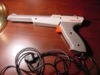 Ever wonder how that Duck Hunt gun worked with your old NES? Here’s how – “Lots of home video games and arcade games use some sort of gun as an input device. You point the gun at the screen and pull the trigger, and if you hit the target on the screen, the target explodes. To create this effect, the gun contains a photodiode (or a phototransistor) in the barrel. The photodiode is able to sense light coming from the screen. The gun also contains a trigger switch. The output of the photodiode and the switch are fed to the computer controlling the game.” [
 Tips for getting rid of the annoying hum – “Of all the annoyances that can afflict any audio/video home theater or even a simple stereo installation, the notorious “ground loop” may well be the most difficult and persistent one to track down and eliminate. A “ground loop” is caused by the difference in electrical potential at different grounding points in an audio/video system. (All the grounds in an A/V system should ideally be at “0” potential.) A ground loop typically adds a loud low-frequency hum or buzz as soon as you plug in any of various audio or video components, including subwoofers, cable-TV outboard boxes, satellite-TV feeds, TV displays, amplifiers, A/V receivers or turntables. The buzz/hum is a byproduct of the multiple power supply cables and a ground voltage differential within your system and its network of interconnecting cables.”
 IBM has some great articles lately – “Historically, the lack of friendly interfaces has been an obstacle to making Linux a commercially viable product for end users, but with available GUIs, that’s yesterday’s news. What’s the next step in creating an easy-to-use Linux-based product for consumers? Imagine adding a user-oriented LCD touchscreen. A touchscreen facade can make back-end Linux applications very usable in such devices as custom digital media centers (either in the home or in automobiles), DVRs and PVRs, and even control interfaces for household robots. The potential uses are limited only by the imagination. In this article, get an overview for installing an LCD taken from a Sony PSOne, creating a modeline, and installing a touchscreen — all for Linux.” Thanks Donald!