



Science

DIY science is the perfect way to use your creative skills and learn something new. With the right supplies, some determination, and a curious mind, you can create amazing experiments that open up a whole world of possibilities. At home-made laboratories or tech workshops, makers from all backgrounds can explore new ideas by finding ways to study their environment in novel ways – allowing them to make breathtaking discoveries!

Engineer Guy vs. Frickin’ Lasers

Engineer Guy vs. Frickin’ Lasers

In this, the fourth installment of Engineer Guy Series #4, Bill, Patrick, and Nick show off the engineering that accounts for three key characteristics of laser light: single wavelengths, narrow beams, and high intensities. Highlights include laser retinal surgery, the difference between phosphorescence and fluorescence, and a rather more sophisticated treatment of laser physics than is common in popular science.

Bacteria Battery from MAKE Volume 30

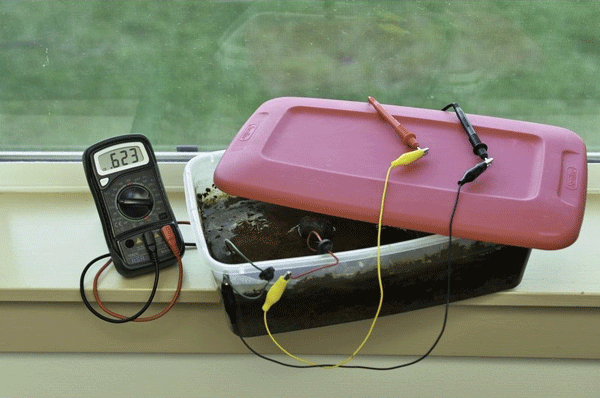
How-To: Bacteria Battery

Did you know you can generate electricity from the “metal-breathing” anaerobic bacteria found in ordinary mud? Having no oxygen to breathe, these bacteria produce energy for their growth by transferring electrons to clumps of rust and other metal oxides, in a process called dissimilatory metal reduction. Dr. Ashley Franks, director of K–12 outreach at the […]

Asteroid-Grabbing Microspines

Asteroid-Grabbing Microspines

NASA JPL researchers present a 250-mm diameter omni-directional anchor that uses an array of claws with suspension flexures, called microspines, designed to grip rocks on the surfaces of asteroids and comets and to grip the cliff faces and lava tubes of Mars. [via Techland; thanks Bigpaws!]