









How King Kong was made…the first one
 Unmuseum.org has a great history of the first Kong movie including how it was made “Released in the spring of 1933 Kong, the story of an oversized ape captured on a remote island in the Pacific and accidentally released on New York City, was an immediate hit. The quality of special effects exceeded all previous pictures and audiences sat amazed as the giant gorilla chased actress Fay Wray through the jungles of Skull Island, and later the concrete canyons of New York City.” Link. In MAKE 02 we have a fun article about making your own stop motion films too.

 Here’s a great new Instructable in the Make group on building a five foot tall Jacob’s ladder from Ewilhelm, he writes “This classic climbing arc completes any mad scientist’s dungeon. Don’t touch the electrodes: they’re at 12 kV! Get a neon sign transformer rated for 9 – 12 kV and 30 mA. Make sure it’s an old style, heavy coil transformer and not solid-state. The solid-state transformers won’t start the arc. I got a Transco 12 kV 30 mA transformer on Ebay for $35. It didn’t have a wall plug, so I wired one on.”…
 Interesting article about “Claytronics” or programmable matter – “The day when doctors routinely made house calls may be past, but that doesn’t mean that someday you won’t routinely see your doctor in your home — with emphasis on “see.” That is to say, your doctor could physically work out of her office. But a three-dimensional lookalike, assembled from perhaps a billion tiny, BB-like robots, could be her stand-in in your home. She could talk with you, touch you, look at you, all under the control of the real, if distant, doc.”
 I asked Scott and Bjoern to write up what they’re up to when I saw the challenge of making a functional music player in 30 minutes, they write “d.tools is a hardware and software system that enables designers to rapidly prototype the bits (the form) and the atoms (the interaction model) of physical user interfaces in concert. d.tools was built to support design thinking rather than implementation tinkering. With d.tools, designers place physical controllers (e.g., buttons, sliders), sensors (e.g., accelerometers), and output devices (e.g., LEDs, LCD screens) directly onto form prototypes, and author their behavior visually in our software workbench.” More info and downloads
 Like VoIP hacks and all things telephony? Check out out O’Reilly’s new Emerging Telephony site – ETel for short – “…covering VoIP, Asterisk, voice and mobile applications, as well as the policy and regulatory issues that impact these important technologies. In addition to daily blogging and the exclusive in-depth articles you’ll find here, we’ll be spotlighting the new related O’Reilly books, like Switching to VoIP and Asterisk: The Future of Telephony and Skype Hacks. We’ll have these authors chiming in on the blog from time to time, too.”
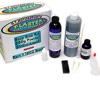 A Make reader is wondering about using “Plastex” – “Have you heard of ‘Plastex’? I’m interested in the home casting materials of plastex and friendly plastic – the former, in particular, anecdotally seems like it make have enough structural integrity to actually make useful items from and not just use it for gap-filling repair work as it is sold, yet seems much easier to work with than the entry-bar for other types of molding. I have not experimented with these items on my ‘to do’ list. (actually I did use friendly plastic as a kid – it melts however at high temperatures which could be a liability).” Have any Makers out there used this stuff? I’ve only see it